Sunday, April 1, 2018

Dino Bios: Carcharodontosaurus.

Carcharodontosaurus:
Carcharodontosaurus from Planet Dinosaur:
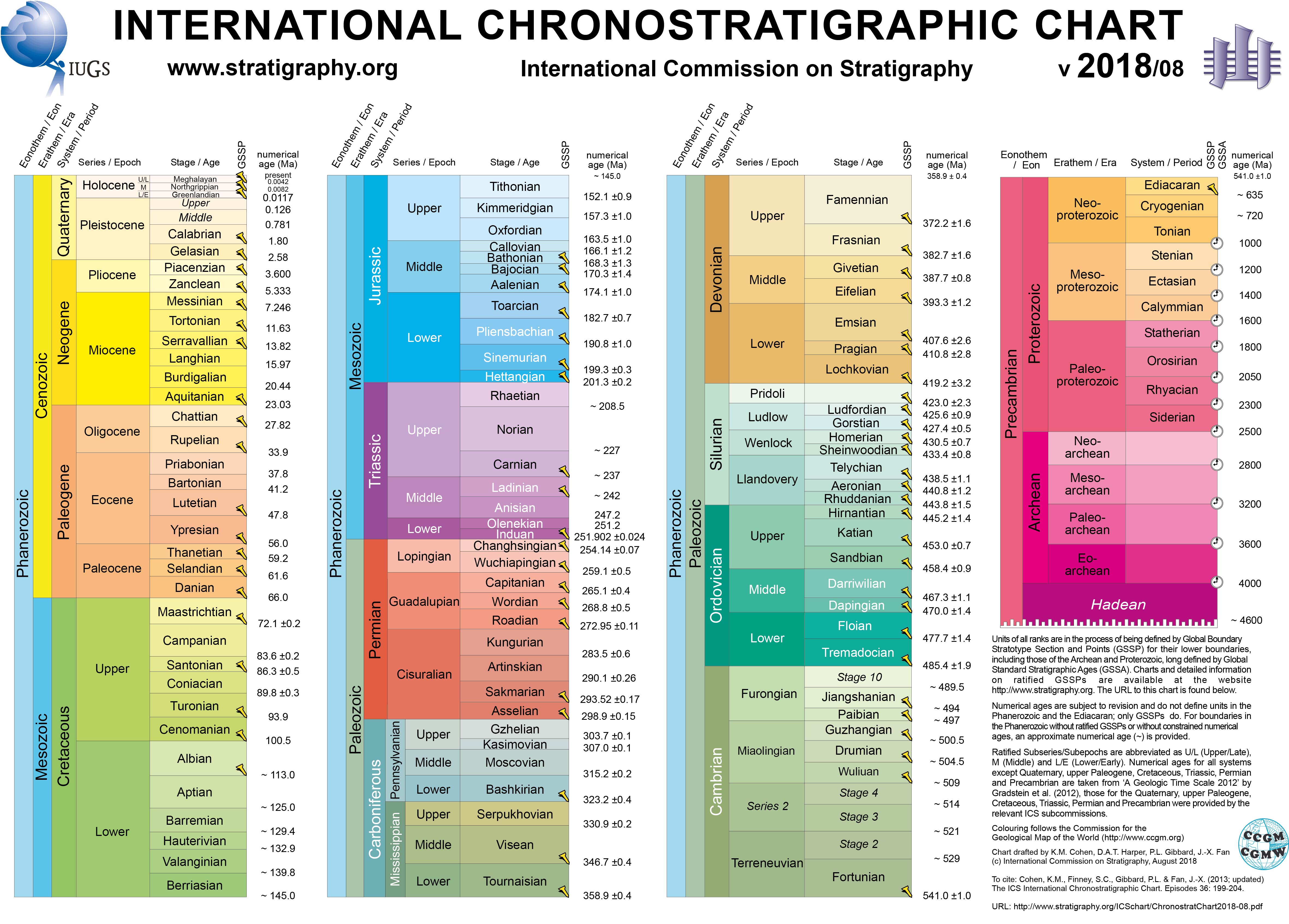
Time: 113-94 million years ago, Albian-Cenomanian of the early-late Cretaceous period.
Place: Africa.
Size: 39-45 feet (11.8-13.8 meters).
Weight: 6-6.8 tons. Maybe more.
Skull: 165.6 cm.
Diet: Carnivore.

Let's talk about Carcharodontosaurus!

Description:
Carcharodontosaurus was a member of the carcharodontosauridae, and the dinosaur from which the name originated from.  It was 39-45 feet long (11.8-13.8 meters), with a maximum skull length of 165.6 cmAs for weight, Henderson and Nicholls (2015) gave 6 tons (Figure 1), and Seebacher (2001) gave 6.8 tons (6,173.2 kg) (pg. 54).

Carnivorous theropod dinosaurs had enamel in their teeth, so they must have had lips to cover and protect their teeth (Reisz and Larson, 2016, pg. 64-66) (Blake Eligh, 2016) (Mindy Weisberger, 2016) (Emanuela Grinberg, 2016) (Phys, 2016). Therefore, Carcharodontosaurus would have had lips covering its teeth. Interestingly, dinosaurs couldn't move its tongues (Mindy Weisberger, 2018)(ScienceDaily, 2018). 
Carcharodontosaurus' jaws were filled with long blade-like teeth which resembled a shark's. For this, it was given the nickname, "the shark-toothed reptile," (Don Lessem, 2010, pg. 79).

According to Kenneth Carpenter (2002), in most predatory theropods used their mouths first to grab prey first, and then they would grab their prey "in a 'bear hug'" with their hands (pg. 72, "Conclusion"). For Allosaurus, a relative of Carcharodontosaurus, its arms were relatively long and robust. The range of motion in its arms seems to have allowed it to grab and pull "moderately large prey" towards it. Carpenter says that evidence of Allosaurus using its arms to hunt large sauropods isn't present ("Biomechanical Analysis," pg. 71). Text-figure 9 shows Allosaurus', and other theropod's, range of motion for their hands (pg. 69). Apparently, it can bend its hand quite well outward. Perhaps this was the same for Carcharodontosaurus. Matt A. White et al., (2015) says that carcharodontosaurid arms were similar to tyrannosaurs, in which they used their jaws to grab their prey first and used their arms to secure it ("Discussion," p. 6). Therefore, it seems that carcharodontosaurids like Carcharodontosaurus used their hands to help their jaws capture prey mainly. However, their hands might have been able to bend slightly like Allosaurus'.

As for speed, Dececchi et al., (2020) says that theropods over 1000 kg would not be able to run fast, despite their different limb lengths. Instead, they were speed-walkers (Dececchi et al., 2020, "Abstract;" "Discussion," "Getting up to speed" p. 3; "Why tyrannosaurids?" p. 2) (EurekAlert, 2020). They could do this for a long time (The Canadian Press, 2020). The young seem to have been faster ("Results," "Relative leg length" p. 1), and pack-hunting was also suggested to help large theropods take down prey (The Canadian Press, 2020) (Dececchi et al., 2020, "Discussion," "Why tyrannosaurids?" p. 2-3).

Sauroniops, a carcharodontosaurid that is said to have lived during the same time and place as Carcharodontosaurus, is now considered to be a synonym of (same animal as) Carcharodontosaurus saharicus (Ibrahim et al., 2020, "Systematics: Theropoda: 'Sauroniops'"). Andrea Cau, one of the Paleontologists that named Sauroniops, disagreed (Cau, Theropoda, 2020, "Sauroniops is not Carcharodontosaurus"). Due to how fragmentary Sauroniops is (only a frontal/piece of the eye exists), I'll leave it alone. 

Time:
Carcharodontosaurus lived 113-94 million years ago, during the Albian-Cenomanian of the early-late Cretaceous period (A.F. de Apparent, 1960, "Age of Continental Intercalaire," p. 11) (Buffetaut and Ouaja, 2002, "Abstract") (Brusatte and Sereno, 2007, pg. 904) (Brusatte et al., 2009, Figure 3) (Benson et al., 2010, Figure 3) (Eddy and Carr, 2011, Figure 55) (Michela Contessa, 2013, pg. 20-29) (Ibrahim et al., 2016, "Abstract," pg. 150) (Candiero et al., 2018, Figure 1) (Ibrahim et al., 2020, "Age" p. 7).

Prey:
Carcharodontosaurus was the most dominant predator on land during its time. Its main prey were medium-giant sauropods, like Aegyptosaurus (52 feet; 15.9 meters), Rebbachisaurus (93 feet; 28.2 meters) and Paralititan (111 feet; 33.7 meters). It also hunted ornithopods, but it's unclear whether or not it hunted Ouranosaurus or a new and unnamed ornithopod, due to fossilized teeth of an ornithopod that has not been identified yet by scientists (Fanti et al., 2016). Ibrahim et al., (2020) discusses a tooth and a footprint found as well that might belong to a small-large ornithopod ("Dinosauria," "Ornithischia").

Enemies:
Carcharodontosaurus co-existed with predators such as Bahariasaurus (38 feet; 11.5 meters), the abelisaurid OLPH 025 (28 feet; 8.6 meters), many crocodyliforms, and perhaps Spinosaurus (29-55 feet long; 8.8-16.8 meters), but Spinosaurus would have preferred rivers instead of land, where Carcharodontosaurus was (Kristen Rogers, 2020, "Competing for food," p. 1).

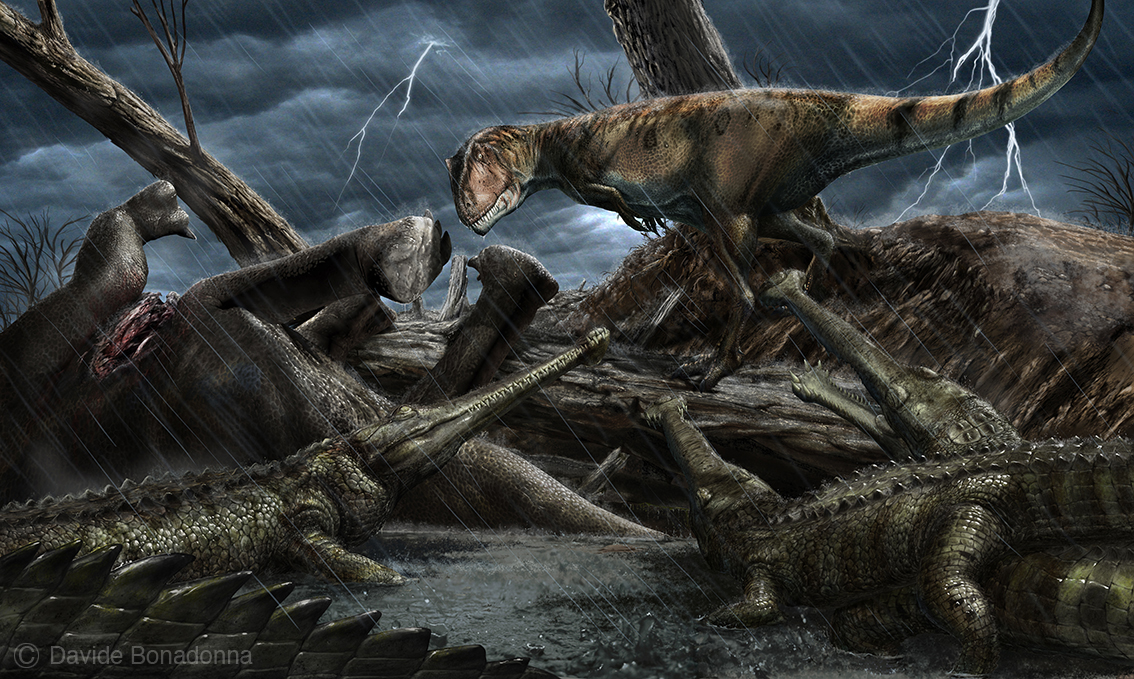
Carcharodontosaurus and Elosuchus by David Bonadonna:
Links:
Stromer (1931) (Part 2):
http://www.dinochecker.com/papers/Stromers-Egypt-expedition_Carcharodontosaurus_Stromer_1931.pdf
Sereno et al., (1996):
https://vdocuments.site/amp/predatory-dinosaurs-from-the-sahara-and-late-cretaceous-faunal-differentiation.html
Time:
A.F. de Apparent (1960) ("Age of Continental Intercalaire," p. 11):
https://paleoglot.org/files/Lapparent_60.pdf
Buffetaut and Ouaja (2002) (Pg. 415-416):
https://core.ac.uk/download/pdf/15484814.pdf
Brusatte and Sereno (2007) (Pg. 904):
https://www.researchgate.net/publication/232678470_A_new_species_of_Carcharodontosaurus_Dinosauria_Theropoda_from_the_Cenomanian_of_Niger_and_a_revision_of_the_genus
Brusatte et al., (2009) (Figure 3):
https://www.researchgate.net/figure/Phylogenetic-relationships-of-Shaochilong-maortuensis-and-other-allosauroid-theropods_fig3_26259477
Benson et al., (2010) (Figure 3):
https://www.researchgate.net/figure/Relationships-of-Cretaceous-allosauroids-based-on-the-phylogenetic-analysis-herein_fig3_272152523?_sg=sg8gP3l_KoTmLPM7P9r-Lu_yNk9SC72jXEy7GrKPInaa4D1wqfQQSERNvHNSCGjUX0VdyILWGIKwJYn1Oo3d5w
Eddy and Clarke (2011) (Figure 55):
https://www.researchgate.net/figure/Phylograms-and-comparisons-of-body-size-optimization-across_fig27_50892373
Link 2:
http://webcache.googleusercontent.com/search?q=cache:OBzyzEUNgKYJ:journals.plos.org/plosone/article/file%3Ftype%3Dsupplementary%26id%3Dinfo:doi/10.1371/journal.pone.0017932.s002+&cd=11&hl=en&ct=clnk&gl=us&client=safari
(Full Article):
https://www.ncbi.nlm.nih.gov/pmc/articles/PMC3061882/
Contessa, Michela. Paleontological studies of Cretaceous vertebrate fossil beds in the Tataouine Basin (southern Tunisia). 2013. Pg. 20-29:
http://amsdottorato.unibo.it/5240/1/Contessi_Michela_tesi.pdf
Ibrahim et al., (2016) ("Abstract," pg. 150):
https://www.researchgate.net/publication/304214496_Evidence_of_a_derived_titanosaurian_Dinosauria_Sauropoda_in_the_Kem_Kem_beds_of_Morocco_with_comments_on_sauropod_paleoecology_in_the_Cretaceous_of_Africa
Candiero et al., (2018) (Figure 1):
https://www.researchgate.net/figure/fig3_326054982
Link 2:
http://www.scielo.br/pdf/paz/v58/1807-0205-paz-58-e20185829.pdf
Ibrahim et al., (2020). Geology and paleontology of the Upper Cretaceous Kem Kem Group of eastern Morocco. ("Age" p. 7):
International Chronostratigraphic Chart (2020):
https://stratigraphy.org/timescale/
International Commission of Stratigraphy Website:
https://stratigraphy.org/news/130
Size:
https://psdinosaurs.blogspot.com/2018/10/calculations-for-largest-theropods.html
Weight:
Henderson and Nicholls (2016) (Figure 1):
https://onlinelibrary.wiley.com/doi/full/10.1002/ar.23164
Seebacher (2001) (pg. 54):
http://dinoweb.ucoz.ru/_fr/4/A_new_method_to.pdf
Lips:
Reisz and Larson (2016) (Pg. 64-66):
https://cansvp.files.wordpress.com/2013/08/csvp-2016-abstract-book-compressed.pdf
Blake Eligh (2016):
https://www.utoronto.ca/news/did-dinosaurs-have-lips-ask-university-toronto-paleontologist
Mindy Weisberger (2016):
https://www.livescience.com/54912-did-t-rex-have-lips.html
Emanuela Grinberg (2016):
https://www.cnn.com/2016/05/22/world/dinosaur-lips-teeth-study/index.html
Phys (2016):
https://phys.org/news/2016-06-dinosaurs-lips.html
Tongue:
Mindy Weisberger (2018):
https://www.scientificamerican.com/article/t-rex-couldnt-stick-out-its-tongue/
ScienceDaily (2018):
https://www.sciencedaily.com/releases/2018/06/180620150129.htm
Teeth:
Don Lessem (2010) (Pg. 79):
https://books.google.com/books?id=pO0EelpDbn8C&printsec=frontcover&dq=the+ultimate+dinopedia&hl=en&newbks=1&newbks_redir=0&sa=X&ved=2ahUKEwiNp7T6wNToAhWQhXIEHSDEBTQQ6AEwAHoECAUQAg#v=onepage&q=the%20ultimate%20dinopedia&f=false
Hands:
Kenneth Carpenter (2002):
https://www.researchgate.net/publication/225366451_Forelimb_biomechanics_of_nonavian_theropod_dinosaurs_in_predation
Matt A. White et al., (2015) ("Discussion," p. 6):
https://journals.plos.org/plosone/article?id=10.1371/journal.pone.0137709
Speed:
Dececchi et al., (2020):
https://www.researchgate.net/publication/336117841_The_fast_and_the_frugal_Divergent_locomotory_strategies_drive_limb_lengthening_in_theropod_dinosaurs
EurekAlert (2020):
https://www.eurekalert.org/pub_releases/2020-05/p-trw051320.php
The Canadian Press (2020):
https://www.kamloopsthisweek.com/news/research-says-t-rex-was-built-for-long-distances-not-sprints-1.24134506
Sauroniops?:
Ibrahim et al., (2020). Geology and paleontology of the Upper Cretaceous Kem Kem Group of eastern Morocco. ("Systematics: Theropoda: 'Sauroniops'"):
Contemporaries:
Contessa, Michela. Paleontological studies of Cretaceous vertebrate fossil beds in the Tataouine Basin (southern Tunisia). 2013. (All: Pages 20-29; Sarcosuchus: Pages 25-26, 28; Spinosaurus, Carcharodontosaurus, and ornithopod: Pages 27-29):
http://amsdottorato.unibo.it/5240/1/Contessi_Michela_tesi.pdf
Ornithopods:
Fanti et al., (2016):
https://www.researchgate.net/publication/290084297_Evidence_of_iguanodontian_dinosaurs_from_the_Lower_Cretaceous_of_Tunisia
Ibrahim et al., (2020) ("Dinosauria," "Ornithischia"):
https://zookeys.pensoft.net/article/47517/element/7/0/deltadromeus/
Stomatosuchus:

https://psdinosaurs.blogspot.com/2020/11/size-calculations-of-crocodyliformes.html

Elosuchus:

https://psdinosaurs.blogspot.com/2020/11/size-calculations-of-crocodyliformes.html

Paralititan:
https://psdinosaurs.blogspot.com/2018/12/size-calculations-for-herbivorous.html
Rebbachisaurus:
https://bioone.org/journals/journal-of-vertebrate-paleontology/volume-35/issue-4/02724634.2014.1000701/Osteology-of-iRebbachisaurus-garasbae-i-Lavocat-1954-a-Diplodocoid-Dinosauria/10.1080/02724634.2014.1000701.short
OLPH 025 (Abelisaurid):
https://psdinosaurs.blogspot.com/2018/10/calculations-for-largest-theropods.html
Spinosaurus:
https://psdinosaurs.blogspot.com/2017/09/spinosaurus-facts.html
Water:
Kristen Rogers (2020) ("Competing for food," p. 1):
https://www.cnn.com/2020/04/29/world/spinosaurus-swimmer-discovery-scn/index.html
Carcharodontosaurus and Elosuchus Picture:
David Bonadonna:
http://www.davidebonadonna.it/project/342/

Tuesday, March 13, 2018

Dino Bios: Allosaurus.

Allosaurus:
Allosaurus: from Walking With Dinosaurs:
Time: 157-145 million years ago, Kimmeridgian-Tithonian of the late Jurassic period.
Place: North America, Europe, and (?)Africa.
Size: 26-52 feet (7.9-15.8 meters).
Weight: 2.3-3 tons (Foth et al., 2011). (Maybe more)
Diet: Carnivore.

Let's talk about my favorite Jurassic carnivore, Allosaurus!

Description:
Allosaurus is the largest carnivorous theropod of late-Jurassic North America. It was 26-52 feet (7.9-15.8 meters), and there are currently six different species of it that roamed North America, Africa, and Europe from the Kimmeridgian-Tithonian. It had two crests on the top of its skull, long arms, and hands with huge claws used for tearing flesh. It's neck muscles "allowed it to whip its head back and forward while attacking its prey" (Burns, 2013, p. 1).

According to Kenneth Carpenter (2002), in most predatory theropods used their mouths first to grab prey first, and then they would grab their prey "in a 'bear hug'" with their hands (pg. 72, "Conclusion"). For Allosaurus, its arms were relatively long and robust. The range of motion in its arms seems to have allowed it to grab and pull "moderately large prey" towards it. Carpenter says that evidence of Allosaurus using its arms to hunt large sauropods isn't present ("Biomechanical Analysis," pg. 71). If it didn't use its hands to hunt sauropods, then perhaps it used its jaws (Burns, 2013, p. 1). Text-figure 9 in Carpenter (2002) shows Allosaurus', and other theropod's, range of motion for their hands (pg. 69). Apparently, it can bend its hand quite well outward.

As for speed, Dececchi et al., (2020) says that theropods over 1000 kg would not be able to run fast, despite their different limb lengths. Instead, they were speed-walkers (Dececchi et al., 2020, "Abstract;" "Discussion," "Getting up to speed" p. 3; "Why tyrannosaurids?" p. 2) (EurekAlert, 2020). They could do this for a long time (The Canadian Press, 2020). The young seem to have been faster ("Results," "Relative leg length" p. 1), and pack-hunting was also suggested to help large theropods take down prey (The Canadian Press, 2020) (Dececchi et al., 2020, "Discussion," "Why tyrannosaurids?" p. 2-3).

A lot of specimens have been called different genera, but now they are all considered to be Allosaurus. This includes Epanterias, Creosaurus, Labrosaurus, Camptonotus, Wyomingraptor, Madsenius, and Antrodemus (Weishampel et al., 2004, pg. 74-75) (Galton et al., 2015) (Mortimer, The Theropod Database Blog, 2015, "Madsenus and Wyomingraptor") (Madsen, 1976/1993, pg. 12-13) (Gilmore, 1920) (Osborn, 1916, pg. 28 figure 27).

Allosaurus' reached its maximum size at age 15 (Bybee et al., 2006, "Abstract") (Joseph Castro, 2016 p. 8), and sexual maturity at around 10 years of age (Lee and Werning, 2008, "Abstract" and "Results, RM Estimated and Skeletochronology").  

Carnivorous theropod dinosaurs had enamel in their teeth, so they must have had lips to cover and protect their teeth (Reisz and Larson, 2016, pg. 64-66) (Blake Eligh, 2016) (Mindy Weisberger, 2016) (Emanuela Grinberg, 2016) (Phys, 2016). Therefore, Allosaurus would have had lips covering its teeth. Interestingly, dinosaurs couldn't move its tongues (Mindy Weisberger, 2018) (ScienceDaily, 2018).

Evers et al., (2020) reconstructed what Allosaurus' skull would have looked liked when it was reconstructed properly. It is similar to the specimen AMNH 600's, which was considered to be "Creosaurus."

Allosaurus Specimen MOR 693's ("Big Al") Skull (Evers et al., 2020, Figure 6):
AMNH 600's Skull (Paleofile) (Osborn, 1903, pg. 698):
It seems that AMNH 600's skull was the accurate Allosaurus skull.

Times and Places:
Allosaurus was discovered in North America and Europe, with a possibility of it being in Africa as well. In North America, Allosaurus fossils come from the Morrison Formation of the late/upper Jurassic period. The Morrison Formation is made up of three major members: Tidwell, Salt Wash, and Brushy Basin (Kowallis et al., 1998, "Abstract") (Scott et al., 2001, pg. 12-14) (The University of Utah, "Morrison Formation"). According to Kowallis et al., (1998), the Tidwell Member is 155 million years old. The Brushy Basin Member is 150-148 million years old. Thus, the Morrison Formation is Kimmeridgian-Tithonian in age ("Abstract"). The Salt Wash Member is located in between the Tidwell and Brushy Basin Members (Chure and Loewen, 2020, "Age"), so it must be around 155-150 million years old. However, the Brushy Basin's maximum age seems to be 153-145 million years old (Kowallis et al., 1991, "Abstract") (Irmis et al., 2013, pg. 282). Therefore, the Salt Wash Member seems to be 155-153 million years old. In total, the Tidwell Member is 157-155 million years old, the Salt Wash Member is 155-153 million years old, and the Brushy Basin Member is 153-145 million years old. In total, the Morrison Formation is Kimmeridgian-Tithonian in age, ranging from 157-145 million years ago. Palynomorphs and calcareous microfossils prove this as well (Turner and Peterson, 1999, pg. 89-90) (Marjanovic and Laurin, 2014, pg. 2) (Dinosaur National Monument, "Rhadinosteus parvus"). Therefore, Allosaurus lived from 157-145 million years ago in North America (Dinosaur National Monument, "The Dinosaurs of Dinosaur").

In Europe, Allosaurus remains come from the Lourinha Formation. The timing of the Lourinha Formation seems to be Kimmeridgian-Tithonian in age (Mateus et al., 2006, pg. 5) (Octavio Mateus, 2006, pg. 2) (Russo et al., 2017, pg. 4) (Mateus et al., 2017, "Lithostratigraphic framework," pg. 80). Therefore, it seems to be the same age as the Morrison Formation (Octavio Mateus, 2006, pg. 2).

In Africa, possible Allosaurus remains come from the Tendaguru Formation. The Tendaguru Formation is Kimmeridgian-Tithonian (Octavio Mateus, 2006, pg. 2) (Kristian Remes, 2006, "Abstract") (Sattler and Schwarz, 2015, "Material"). (?)Allosaurus remains come from the Lower Dinosaur and Middle Dinosaur Members of the Tendaguru Formation, which are both Kimmeridgian in age (Bussert et al., 2009, "Members of the Tendaguru Formation," "Lower Dinosaur Member" and "Middle Dinosaur Member," pg. 156-157, 160-162)However, the Allosaurus fossil discovered there, called Allosaurus tendagurensis, is considered a nomen dubium (questionable) (Oliver M. W. Rauhut, 2011, pg. 209).

In summary, Allosaurus lived during the Kimmeridgian-Tithonian of late-Jurassic North America and Europe. It might have also lived in Africa, but it's not for certain.

Sizes and Species:
The amount of species that pertain to Allosaurus are numerous. So far, I've been able to find seven. However, according to Evers et al., (2020), there doesn't seem to be any diagnostic features between the multiple species of Allosaurus, based on a study of multiple skulls (mainly cheek or jugal bones) ("Introduction," Figure 5, "Discussion," and "Conclusion"). Therefore, it seems that Allosaurus fragilis is the only valid species of Allosaurus so far. All specimens listed below belong to Allosaurus fragilis until further notice.

1. USNM 4734:
Length: 26 feet (7.9 meters).

USNM 4734's Skull (Paleofile):
2. MOR 693 ("Big Al"):
Length: 35 feet (10.6 meters).
Age: Subadult.
Adult Length: 39 feet (12.0 meters).

MOR 693 ("Big Al"):
3. OMNH 01935:
Length: 43 feet (13.0 meters).

OMNH 01935's Humerus (Left) (Cuesta et al., 2018): 
4. AMNH 5767:
Length: 52 feet (15.8 meters).

AMNH 5767 (from Paleofile):
Prey:
Allosaurus' prey consisted of sauropods, ornithopods, and stegosaurs. In North America for example, Allosaurus hunted the sauropods Barosaurus, Brachiosaurus and Camarasaurus, Maraapunisaurus, and other herbivores like Camptosaurus, Stegosaurus, and Mymoorapelta. In Africa, it hunted the stegosaur Kentrosaurus and the sauropod Giraffatitan.

Allosaurus vs. Stegosaurus from Walking With Dinosaurs Ep. 2-Time of the Titans:
Enemies:
Allosaurus' enemies were numerous. In North America, it consisted of Ceratosaurus, Torvosaurus, Stokesosaurus, and Saurophaganax. In (?)Africa, it consisted of (?)Ceratosaurus and Veterupristisaurus. In Europe, it consisted of Ceratosaurus, Torvosaurus, and Lusovenator.

Links:
Times and Places:
Morrison Formation:
Kowallis et al., (1991) ("Abstract"):
https://www.sciencedirect.com/science/article/pii/019566719190003U
Full:
http://geology.byu.edu/Home/sites/default/files/kowallis_agebrushybasin_91.pdf
Kowallis et al., (1998) ("Abstract"):
http://geology.byu.edu/home/sites/default/files/kowallis_morrison_age_98.pdf
Turner and Peterson (1999) ("Age," pg. 89-90):
https://books.google.com/books?hl=en&lr=&id=qeRM16ndBx4C&oi=fnd&pg=PA77&ots=W5Kj88zd2x&sig=CZ76lISv4Bbi3BXBoWcGMHGg124#v=onepage&q&f=false
Scott et al., (2001) (Pg. 12-14):
https://pubs.usgs.gov/imap/i-2740/i-2740pm.pdf
Irmis et al., (2013) (Pg. 282):
https://www.researchgate.net/publication/260632793_Early_Crocodylomorpha
Marjanovic and Laurin (2014) (Pg. 2):
https://www.researchgate.net/publication/260075695_69_Marja_Laurin_App_comp
Chure and Loewen (2020) ("Age"):
https://peerj.com/articles/7803/
The University of Utah ("Morrison Formation"):
https://sed.utah.edu/Morrison.htm
Dinosaur National Monument ("Rhadinosteus parvus"):
https://www.nps.gov/dino/learn/nature/rhadinosteus-parvus.htm
Dinosaur National Monument ("The Dinosaurs of Dinosaur"):
https://www.nps.gov/dino/learn/nature/dinosaurs-of-dinosaur.htm
Lourinha Formation:
Russo et al., (2017) (Pg. 4):
Mateus et al., (2006) (pg. 5):
https://docentes.fct.unl.pt/sites/default/files/omateus/files/mateus_walen_antunes_-_2006_-_the_large_theropod_fauna_of_the_lourinha_formation__portugal__and_its_similarity_to_the_morrison_formation__with_a_description_of_a_new_species_of_allosaurus.pdf
Octavio Mateus (2006) (Pg. 2):
https://www.researchgate.net/publication/40662981_Late_Jurassic_dinosaurs_from_the_Morrison_formation_USA_the_Lourinha_and_Alcobaca_Formations_Portugal_and_the_Tendaguru_Beds_Tanzania_a_comparison
Tendaguru Formation:
Sattler and Schwarz (2015) ("Material"):
Oliver M. W. Rauhut (2011) (Pg. 199-202; 202-205)
https://www.academia.edu/25456862/Theropod_dinosaurs_from_the_Late_Jurassic_of_Tendaguru_Tanzania
Bussert et al., (2009) ("Members of the Tendaguru Formation," "Lower Dinosaur Member" and "Middle Dinosaur Member," pg. 156-157, 160-162):
https://www.researchgate.net/publication/307714593_The_Tendaguru_Formation_Late_Jurassic_to_Early_Cretaceous_southern_Tanzania_definition_palaeoenvironments_and_sequence_stratigraphy
Kristian Remes (2006) ("Abstract"):
International Chronostratigraphic Chart (2020):
International Commission of Stratigraphy Website:
Specimens and Size:
https://psdinosaurs.blogspot.com/2020/07/size-calculations-for-allosaurus.html
Link 2:
Link 3:
https://psdinosaurs.blogspot.com/2018/01/carnivorous-theropod-sizes.html
Verified:
Othniel Charles Marsh (1877):
http://marsh.dinodb.com/marsh/Marsh%201877%20-%20Notice%20of%20new%20dinosaurian%20reptiles%20from%20the%20Jurassic%20formation.pdf
Evers et al., (2020) ("Introduction," Figure 5, "Discussion," and "Conclusion"):
https://peerj.com/articles/8493/
How Many Species of Allosaurus Are There!?:
https://psdinosaurs.blogspot.com/2020/02/how-many-species-of-allosaurus-are-there.html
Questionable Species:
Weishampel et al., (2004) (Pg. 74-75):

https://www.google.com/books/edition/The_Dinosauria/h4WRTHfTzXsC?q=baryonyx+tenerensis&gbpv=1&bsq=creosaurus#f=false
Mortimer. The Theropod Database Blog. "Madsenus and Wyomingraptor." 2015:

https://theropoddatabase.blogspot.com/2015/01/madsenius-and-wyomingraptor.html?m=1

Madsen (1976/1993) (Pg. 12-13):

Galton et al., (2015):
Oliver W. M. Rauhut (2011) (pg. 209):
Osborn (1916) (Pg. 28 figure 27):

http://digitallibrary.amnh.org/handle/2246/49

Weight:
Foth et al., (2011):
https://peerj.com/articles/940.pdf
Age:
Bybee et al., (2006):
Joseph Castro (2016):
Lee and Werning (2008) ("Abstract" and "Results," "RM Estimated and Skeletochronology"):
Lips:
Reisz and Larson (2016) (Pg. 64-66):
https://cansvp.files.wordpress.com/2013/08/csvp-2016-abstract-book-compressed.pdf
Blake Eligh (2016):
https://www.utoronto.ca/news/did-dinosaurs-have-lips-ask-university-toronto-paleontologist
Mindy Weisberger (2016):
https://www.livescience.com/54912-did-t-rex-have-lips.html
Emanuela Grinberg (2016):
https://www.cnn.com/2016/05/22/world/dinosaur-lips-teeth-study/index.html
Phys (2016):
https://phys.org/news/2016-06-dinosaurs-lips.html
Tongue:
Mindy Weisberger (2018):
https://www.scientificamerican.com/article/t-rex-couldnt-stick-out-its-tongue/
ScienceDaily (2018):
https://www.sciencedaily.com/releases/2018/06/180620150129.htm
Skull:
Evers et al., (2020) (Figure 6):
https://peerj.com/articles/8493/
How Many Species of Allosaurus Are There!?:
Jaw Strength:
Prey:
Enemies:
Dinosaur National Monument ("The Dinosaurs of Dinosaur"):
https://www.nps.gov/dino/learn/nature/dinosaurs-of-dinosaur.htm
Ceratosaurus:
Stokesosaurus:

Monday, January 22, 2018

Carnivorous Theropods Sizes.

T. rex:
Time Period: Campanian-Maastrichtian of the late Cretaceous period: 84-66 million years ago.
Place: North America, Canada, and Mexico.
Length: 40-70 feet (12.2-21.3 meters).

Allosaurus:
Time Period: Kimmeridgian-Tithonian of the late Jurassic period: 157-145 million years ago.
Place: North America, Europe, and Africa.
Length: 26-44 feet (7.9-13.4 meters).

Mapusaurus:
Time Period: Cenomanian-Coniacian of the early-late Cretaceous period: 101-86 million years ago.
Place: South America.
Length: 36-50 feet (10.9-15.3 meters).

Giganotosaurus: 
Time Period: Albian of the early-late Cretaceous period: 113-101 million years ago.
Place: South America.
Length: 41-43 feet (12.4-13.1 meters).

Tyrannotitan:
Time Period: Aptian of the early Cretaceous period: 125-113 million years ago.
Place: South America.
Length: 35-42 feet (10.6-12.9 meters).

Carcharodontosaurus:
Time Period: Albian-Cenomanian of the early-late Cretaceous period: 113-94 million years ago.
Place: Africa.
Length: 39-45 feet (11.8-13.8 meters).

Saurophaganax:
Time Period: Kimmeridgian-Tithonian of the late Jurassic period: 152-145 million years ago.
Place: North America.
Length: 28-36 feet (8.4-11.1 meters).

Ceratosaurus: 
Time Period: Kimmeridgian-Tithonian of the late Jurassic period: 152-145 million years ago.
Place: North America, Europe, and probably Africa.
Length: 18-31 feet (5.4-9.5 meters).

Spinosaurus: 
Time Period: Albian-Cenomanian of the early-late Cretaceous period: 113-94 million years ago.
Place: Africa and South America.
Length: 29-47 feet (8.8-14.2 meters).

Siats: 
Time Period: Cenomanian of the late Cretaceous period: 101-94 million years ago.
Place: North America.
Length:
Age: 16 (At best?/My guess): 36 feet (11.0 meters)
Age 18: 37 feet (11.3 meters)(?).

Baryonyx: 
Time Period: Barremian-Aptian of the early Cretaceous period: 129-113 million years ago.
Places: Europe and Africa.
Length: 25-33 feet (7.6-10.0 meters).

Utahraptor: 
Time Period: Berriasian-Hauterivian of the early Cretaceous period, 145-129 million years ago.
Place: North America.
Length: 17-18 feet (5.2-5.6 meters).

Dakotaraptor: 
Time Period: Maastrichtian of the late Cretaceous period: 72-66 million years ago.
Place: North America.
Length: 13-17 feet (3.8-5.2 meters).

Achillobator: 
Time Period: Santonian-Campanian of the late Cretaceous period: 86-72 million years ago.
Place: Asia.
Length: 15 feet (4.7 meters).

Bahariasaurus: 
Time Period: Cenomanian of the late Cretaceous period: 101-94 million years ago.
Place: Africa.
Length: 38 feet (11.5 meters).

Acrocanthosaurus: 
Time Period: Albian of the early Cretaceous period: 113-101 million years ago.
Place: North America.
Length: 34-39 feet (10.2-12.0 meters).

Deinonychus: 
Time Period: Albian of the early Cretaceous period: 113-101 million years ago.
Place: North America.
Length: 10 feet (3.1 meters).

Austroraptor: 
Time Period: Maastrichtian of the late Cretaceous period: 72-66 million years ago.
Place: South America.
Length: 17 feet (5.3 meters).

Tarbosaurus: 
Time Period: Campanian-Maastrichtian of the late Cretaceous period: 84-66 million years ago. Maybe 65 million years ago.
Place: Asia.
Length: 31-39 feet (9.3-12.0 meters).

Zhuchengtyrannus:
Time Period: Campanian-Maastrichtian of the late Cretaceous period: 84-66 million years ago. Maybe 65 million years ago.
Place: Asia.
Length: 34 feet (10.3 meters).

Carnotaurus: 
Time Period: Maastrichtian of the late Cretaceous to Paleocene: 72-66 million years ago.
Place: South America.
Length: 32 feet (9.6 meters).

Pycnonemosaurus: 
Time Period: Coniacian of the late Cretaceous period: 90-86 million years ago.
Place: South America.
Length: 27 feet (8.2 meters).

Torvosaurus: 
Time Period: Kimmeridgian-Tithonian of the late Jurassic period: 157-145 million years ago.
Place: North America and Europe.
Length: 33-35 feet (10.1-10.7 meters).

Coelophysis: 
Time Period: Norian-Toarcian of the late Triassic-early Jurassic: 227-174 million years ago.
Place: North America and Africa.
Length: 5-8 feet (1.5-2.5 meters).

Herrerasaurus: 
Time Period: Norian-Rhaetian of the late Triassic period: 227-201 million years ago.
Place: South America.
Length: 11 feet (3.1-3.4 meters).

Eodromaeus:
Time Period: Carnian of the late Triassic period: 237-227 million years ago.
Place: South America.
Length: 8 feet (2.4 meters).

Neovenator:
Time Period: Barremian of the early Cretaceous period: 129-125 million years ago.
Place: Europe.
Length: 30 feet (9.1 meters).

Eotyrannus:
Time Period: Barremian of the early Cretaceous period: 129-125 million years ago.
Place: Europe.
Length: 13 feet (4.0 meters).

Ekrixinatosaurus: 
Time Period: Albian-Coniacian of the early-late Cretaceous period: 113-86 million years ago.
Place: South America.
Length: 24 feet (7.2 meters).

Irritator:
Time Period: Aptian of the early Cretaceous period: 125-113 million years ago.
Place: South America.
Length: 22-31 feet (6.8-9.3 meters).

Gnathovorax:
Time: Carnian of the late Triassic period: 237-227 million years ago.
Place: South America.
Length: 10 feet (3.1 meters).

Order of Size: 
1. Tyrannosaurus rex: 40-70 feet (12.2-21.3 meters).
2. Mapusaurus: 36-50 feet (10.9-15.3 meters).
3. Spinosaurus: 29-47 feet (8.8-14.2 meters).
4. Carcharodontosaurus: 35-45 feet (10.8-13.8 meters).
5. Allosaurus: 26-44 feet (7.9-13.4 meters).
6. Giganotosaurus: 41-43 feet (12.4-13.1 meters).
7. Tyrannotitan: 35-42 feet (10.6-12.9 meters).
8. Acrocanthosaurus: 34-39 feet (10.2-12.0 meters).
9. Tarbosaurus: 31-39 feet (9.3-12.0 meters).
10. Siats: 36-37 feet (11.0-11.3 meters).
11. Bahariosaurus: 36 feet (11.1 meters).
12. Saurophaganax: 28-36 feet (8.4-11.1 meters).
13. Torvosaurus: 33-35 feet (10.1-10.7 meters).
14. Zhuchengtyrannus: 34 feet (10.3 meters).
15. Baryonyx: 25-33 feet (7.6-10.0 meters).
16. Carnotaurus: 32 feet (9.6 meters).
17. Irritator22-31 feet (6.8-9.3 meters).
18. Neovenator: 30 feet (9.1 meters).
19. Pycnonemosaurus: 27 feet (8.2 meters).
20. Ekrixinatosaurus: 24 feet (7.2 meters).
21. Ceratosaurus: 18-31 feet (5.4-9.5 meters).
22. Utahraptor: 17-18 feet (5.2-5.6 meters).
23. Austroraptor: 17 feet (5.3 meters).
24. Dakotaraptor: 13-17 feet (3.8-5.2 meters).
25. Achillobator: 15 feet (4.7 meters).
26. Eotyrannus: 13 feet (4.0 meters).
27. Herrerasaurus: 11 feet (3.1-3.4 meters).
28. Deinonychus: 10 feet (3.1 meters).
29. Gnathovorax: 10 feet (3.1 meters).
30. Coelophysis: 5-8 feet (1.5-2.5 meters).
31. Eodromaeus: 8 feet (2.4 meters).

Links:
My Dinosaur Lengths:
https://psdinosaurs.blogspot.com/2018/10/calculations-for-largest-theropods.html
Time Periods:
International Chronostratigraphic Chart (2020):
International Commission of Stratigraphy Website:

Thursday, December 21, 2017

Dino Bios: Megalneusaurus.

Megalneusaurus:
Time: 164-145 million years ago, Oxfordian-Tithonian of the late Jurassic period.
Place: North America.
Length: 47-52 feet (14.4-15.8 meters).
Skull Length: 272.4-300 cm.
Diet: Carnivore.

This is my favorite pliosaur, but it isn't that well known. So let's talk about it!

Description:
The pliosauroidea were large marine reptiles that were the top predators of their time. Megalneusaurus was one of the largest pliosaurs to have lived. The holotype, UW 4602, and UANL-FCT-R2, the "Monster of Aramberri" specimen, were 52 feet (15.8 meters) long and had skulls that were 300 cm long. Another specimen from Alaska was 47 feet (14.4 meters) long, with a skull that was 272.4 cm long. These large skulls, along with their large bodies, gave large pliosaurs the ability to hunt a variety of prey (Foffa et al., 2014, "Conclusions").

UANL-FCT-R2 ("Monster of Aramberri) Skull (Vengeance from the Deep, "Pliosaur Size"):
Prey:
Megalneusaurus hunted the ichthyosaurs Ophthalmosaurus and Baptanodon, and the plesiosaurs Pantosaurus and Tatenectes.

Megalneusaurus Hunting Ophthalmosaurus:
Links:
Original Papers:
Science (1895):
https://science.sciencemag.org/content/2/40/449.1
Knight (1898) (pg. 379):
https://books.google.com/books?id=9FY7AQAAIAAJ&pg=PA380&lpg=PA380&dq=megalneusaurus+centrum+width&source=bl&ots=I0pjh9Mzig&sig=ACfU3U3BIE5eFVswQm7hKyhPl12Ik4AALw&hl=en&sa=X&ved=2ahUKEwia8c-ouaTiAhXo1FkKHSNQDNsQ6AEwAnoECAkQAQ#v=onepage&q=megalneusaurus%20centrum%20width&f=false
Size:
https://psdinosaurs.blogspot.com/2019/05/size-calculations-for-pliosaurs.html
Time:
International Chronostratigraphic Chart (2019 Version):
http://stratigraphy.org/ICSchart/ChronostratChart2019-05.jpg
Link 2:
http://stratigraphy.org/index.php/ics-chart-timescale
Time:
Wahl et al., (2007) ("Abstract"):
https://www.academia.edu/2903720/Rediscovery_of_Wilbur_Knights_Megalneusaurus_rex_site_New_material_from_an_old_pit 
Weems and Blodgett (1996) (Pg. 173-174):
https://books.google.com/books?id=kFdRAQAAIAAJ&pg=PA173&lpg=PA173&dq=megalneusaurus+humerus&source=bl&ots=2lz_AfTT0e&sig=ACfU3U2SF9blC3VoHyw5BkewmJSKlBjv-Q&hl=en&sa=X&ved=2ahUKEwih6Jfg0vHjAhVsm-AKHQkZBPIQ6AEwBXoECAkQAQ#v=onepage&q=megalneusaurus%20humerus&f=false 
Wilson et al., (2015) ("Abstract"):
https://mrdata.usgs.gov/sim3340/show-sim3340.php?seq=B142&src=UG004_514 
Tropaff et al., (2005) ("Abstract"):
https://pubs.geoscienceworld.org/gsa/gsabulletin/article-abstract/117/5-6/570/2164/sedimentology-and-provenance-of-the-upper-jurassic?redirectedFrom=fulltext
Hugh McClean (1979) ("Introduction"):
Ralph W. Imlay (1981) (Pg. 24-28):
International Chronostratigraphic Chart (2020):
International Commission of Stratigraphy Website:
Locations:
Wyoming:
Wahl et al., (2007):
https://www.academia.edu/2903720/Rediscovery_of_Wilbur_Knights_Megalneusaurus_rex_site_New_material_from_an_old_pit
Wahl et al., (2010):
https://www.academia.edu/2903646/New_material_from_the_type_specimen_of_Megalneusaurus_rex_Reptilia_Sauropterygia_from_the_Jurassic_Sundance_Formation_Wyoming
Alaska:
Weems and Blodgett (1996):
1st Link (pg. 169):
https://ecos.fws.gov/ServCat/DownloadFile/129372?Reference=85097
2nd Link:
https://images.app.goo.gl/YWQcwxWxVgfmqtwE7
3nd Link:
https://data.doi.gov/dataset/the-pliosaurid-megalneusaurus-a-newly-recognized-occurrence-in-the-upper-jurassic-naknek-f
Mexico:
Buchy et al., (2003):
Buchy (2007) (pg. 36-40):
Bite Force:
Foffa et al., (2014) ("Conclusions"):

https://onlinelibrary.wiley.com/doi/full/10.1111/joa.12200

Prey:

Wahl et al., (2007) (pg. 94):
O'Keefe et al., (2009):
https://www.jstor.org/stable/20627139?seq=1#page_scan_tab_contents
Pliosauroidea:
Weems and Blodgett (1996) (pg. 170):
Pliosaur Physical Description:
"A New Species of Pliosaur Was Found on Volga." National Geographic. 2016:
Skull Picture:
Vengeance from the Deep. "Pliosaur Size":

Friday, November 24, 2017

Dino Bios: Carnotaurus.

Carnotaurus:
Carnotaurus' 2021 redesign based on skin impressions (Phys, 2021):
Time: 72.1-66 million years ago, Maastrichtian of the late Cretaceous period (possibly longer).
Place: South America.
Size: 32 feet (9.6 meters).
Diet: Carnivore.

Let's talk about my second favorite dinosaur: Carnotaurus!

Description:
Carnotaurus is an abelisaurid from Patagonia, South America (Bonaparte et al., 1990, "Abstract") (Ezcurra and Novas, 2016, pg. 150). It lived 72-66 million years ago (Ezcurra and Novas, 2016, p. 150) (Rafael Delcourt, 2018, Figure 1) (Leanza et al., 2004, p. 71), but it has been suggested to have lived possibly from the Campanian-Maastrichtian periods (83.6-72.1 million years ago) (Hendrickx and Bell, 2021, Materials and methods, para. 2). It was originally thought that Carnotaurus was discovered in the Gorro Frillo Formation (Bonaparte et al., 1990, "Abstract"), but now it is considered to have come from the La Colonia Formation (Ezcurra and Novas, 2016, p. 150) (Hendrickx and Bell, 2021, Materials and methods, para. 2). 

Carnotaurus was 32 feet (9.6 meters) in length. It had a relatively big head with two horns above its eyes. It had arms and hands smaller than T. rex! It's arms also supported four-fingered hands. It supported two horns on the top of its eyes that faced forward.

Carnivorous theropod dinosaurs had enamel in their teeth, so they must have had lips to cover and protect their teeth (Reisz and Larson, 2016, pg. 64-66) (Blake Eligh, 2016) (Mindy Weisberger, 2016) (Emanuela Grinberg, 2016) (Phys, 2016). Therefore, Carnotaurus would have had lips covering its teeth. Interestingly, dinosaurs couldn't move its tongues (Mindy Weisberger, 2018) (ScienceDaily, 2018).

Prey:
Dinosaurs that were on the menu for Carnotaurus were the titanosaurs Saltasaurus (28-46 feet; 8.4-13.9 meters), Argyrosaurus (78 feet; 23.8 meters), and Puertasaurus; and the ornithopod Willinakaqe (24-25 feet; 7.2-7.7 meters).

Willinakaqe (Valieri et al., 2010) (Figure 2):
Top Predator:
Carnotaurus was an abelisaur, and was the top predator of its environment. The abelisaurs were subordinate to the carcharodontosaur family for most of the Cretaceous period. This is evident with Ekrixinatosaurus and Skorpiovenator being overpowered Giganotosaurus carolinii and G. (Mapusaurus) roseae. Rugops was subordinate to Carcharodontosaurus saharicus. When the carcharodontosaurs died out, the abelisaurs rose to power. This happened at the end of the Santonian. when the Campanian period began, the abelisaurs became the top predators.

Dinosaur (2000):
Carnotaurus from Dinosaur:
Carnotaurus was the main villain for one of my favorite childhood movies, Dinosaur. Originally, it was going to be T. rex, but it was changed to Carnotaurus (Donald R. Prothero, 2016, pg. 19). This explains why Carnotsaurus was so large in the film, compared to what it was in real life. Without this movie, I would have never known, or heard, of CarnotaurusCarnotaurus hunts Aladar, and Iguanodon, in the film. Carnotaurus didn't hunt Iguanodon, since Iguanodon lived in Europe and in the early Cretaceous, but it probably hunted Willinakaqe.

Links:
Original Paper:
Bonaparte et al., (1990):
2021 Redesign:
Phys (2021):
https://phys.org/news/2021-09-scientists-reveal-fossilised-skin-bull-like.html
Size:
https://psdinosaurs.blogspot.com/2018/10/calculations-for-largest-theropods.html
Time:
Ezcurra and Novas (2016) (P. 150):
https://www.researchgate.net/publication/305011083_Theropod_dinosaurs_from_Argentina
Rafael Delcourt (2018) (Figure 1):
https://www.nature.com/articles/s41598-018-28154-x
Hendrickx and Bell (2021) (Materials and methods, para. 2):
https://www.sciencedirect.com/science/article/abs/pii/S0195667121002421
International Chronostratigraphic Chart (2020):
https://stratigraphy.org/timescale/
International Commission of Stratigraphy Website:
https://stratigraphy.org/news/130
Dinosaur Movie Info:
Donald R. Prothero (2016) (Pg. 19):
https://books.google.com/books?id=y79nCwAAQBAJ&pg=PA28&lpg=PA28&dq=carcharodontosaurus+12+to+13+meters&source=bl&ots=mQcnd67tpi&sig=Litfa9DQ_hD2JEakHd2_CWX163M&hl=en&sa=X&ved=2ahUKEwiW_sOf4P7dAhXErFkKHQGSA7oQ6AEwHnoECAoQAQ#v=onepage&q=carnotaurus&f=false
Lips:
Reisz and Larson (2016) (Pg. 64-66):
https://cansvp.files.wordpress.com/2013/08/csvp-2016-abstract-book-compressed.pdf
Blake Eligh (2016):
https://www.utoronto.ca/news/did-dinosaurs-have-lips-ask-university-toronto-paleontologist
Mindy Weisberger (2016):
https://www.livescience.com/54912-did-t-rex-have-lips.html
Emanuela Grinberg (2016):
https://www.cnn.com/2016/05/22/world/dinosaur-lips-teeth-study/index.html
Phys (2016):
https://phys.org/news/2016-06-dinosaurs-lips.html
Tongue:
Mindy Weisberger (2018):
https://www.scientificamerican.com/article/t-rex-couldnt-stick-out-its-tongue/
ScienceDaily (2018):
https://www.sciencedaily.com/releases/2018/06/180620150129.htm
Strong Neck:
Ariel H. Mendez (2012):
https://bioone.org/journals/acta-palaeontologica-polonica/volume-59/issue-3/app.2011.0129/The-Cervical-Vertebrae-of-the-Late-Cretaceous-Abelisaurid-Dinosaur-Carnotaurus/10.4202/app.2011.0129.full
Riley Black (2012):
https://www.smithsonianmag.com/science-nature/carnotaurus-had-a-hefty-neck-24787083/
Other Papers:
Skull Info.:
Cerroni et al., (2021) (Supplementary Materials):
https://figshare.com/articles/dataset/The_skull_of_i_Carnotaurus_sastrei_i_Bonaparte_1985_revisited_insights_from_craniofacial_bones_palate_and_lower_jaw/12848981?file=24407432
Prey:
Saltasaurus:
https://psdinosaurs.blogspot.com/2018/12/size-calculations-for-herbivorous.html
Zurriaguz and Powell (2015) (Pg. 284):
https://www.researchgate.net/publication/271854004_New_contributions_to_the_presacral_osteology_of_Saltasaurus_loricatus_Sauropoda_Titanosauria_from_the_Upper_Cretaceous_of_northern_Argentina
Argyrosaurus
Length:
https://psdinosaurs.blogspot.com/2018/12/size-calculations-for-herbivorous.html
Time:
Mannion and Otero (2012) (Pg. 616):
https://www.researchgate.net/publication/235635155_A_Reappraisal_of_the_Late_Cretaceous_Argentinean_Sauropod_Dinosaur_Argyrosaurus_superbus_with_a_Description_of_a_New_Titanosaur_Genus
Casal et al., (2016) (Spanish) ("Abstract," Pg. 59 "Age of the Lago Colhue Huapi Formation"/"Edad de la Formacion Lago Colhue Huapi"):
https://www.researchgate.net/publication/303598984_Ordenamiento_y_caracterizacion_faunistica_del_Cretacico_Superior_del_Grupo_Chubut_Cuenca_del_Golfo_San_Jorge_Argentina
English Version:
https://webcache.googleusercontent.com/search?q=cache:Ytyd4o1h6aEJ:https://doi.org/10.4072/rbp.2016.1.05+&cd=4&hl=en&ct=clnk&gl=us
Vallati et al., (2016) ("Abstract"):
https://app.dimensions.ai/details/publication/pub.1006664406
Lamanna et al., (2019) ("Abstract"):
https://bioone.org/journals/Annals-of-Carnegie-Museum/volume-85/issue-3/007.085.0301/A-New-Peirosaurid-Crocodyliform-from-the-Upper-Cretaceous-Lago-Colhu%c3%a9/10.2992/007.085.0301.short
Ibiricu et al., (2019) ("Abstract"):
https://www.researchgate.net/publication/337834456_New_materials_and_an_overview_of_Cretaceous_vertebrates_from_the_Chubut_Group_of_the_Golfo_San_Jorge_Basin_central_Patagonia_Argentina
Size:
https://psdinosaurs.blogspot.com/2018/12/size-calculations-for-herbivorous.html
Time:
Leanza et al., (2004) (Pg. 71):
https://www.researchgate.net/publication/257047651_Cretaceous_terrestrial_beds_from_the_Neuquen_Basin_Argentina_and_their_tetrapod_assemblages
Valieri et al., (2010) (Pg. 219-220):
https://web.archive.org/web/20110903014352/http://www.macn.secyt.gov.ar/investigacion/descargas/publicaciones/revista/12/rns_vol12-2_217-231.pdf
Link 2:
http://www.scielo.org.ar/scielo.php?script=sci_arttext&pid=S1853-04002010000200006
Garcia and Salgado (2013) ("Location and geological setting"):
https://www.app.pan.pl/archive/published/app58/app20110055.pdf
Ezcurra and Novas (2016) (Pg. 150):
https://www.researchgate.net/publication/305011083_Theropod_dinosaurs_from_Argentina