Utahraptor:
Name: Utahraptor ostrommaysorum.
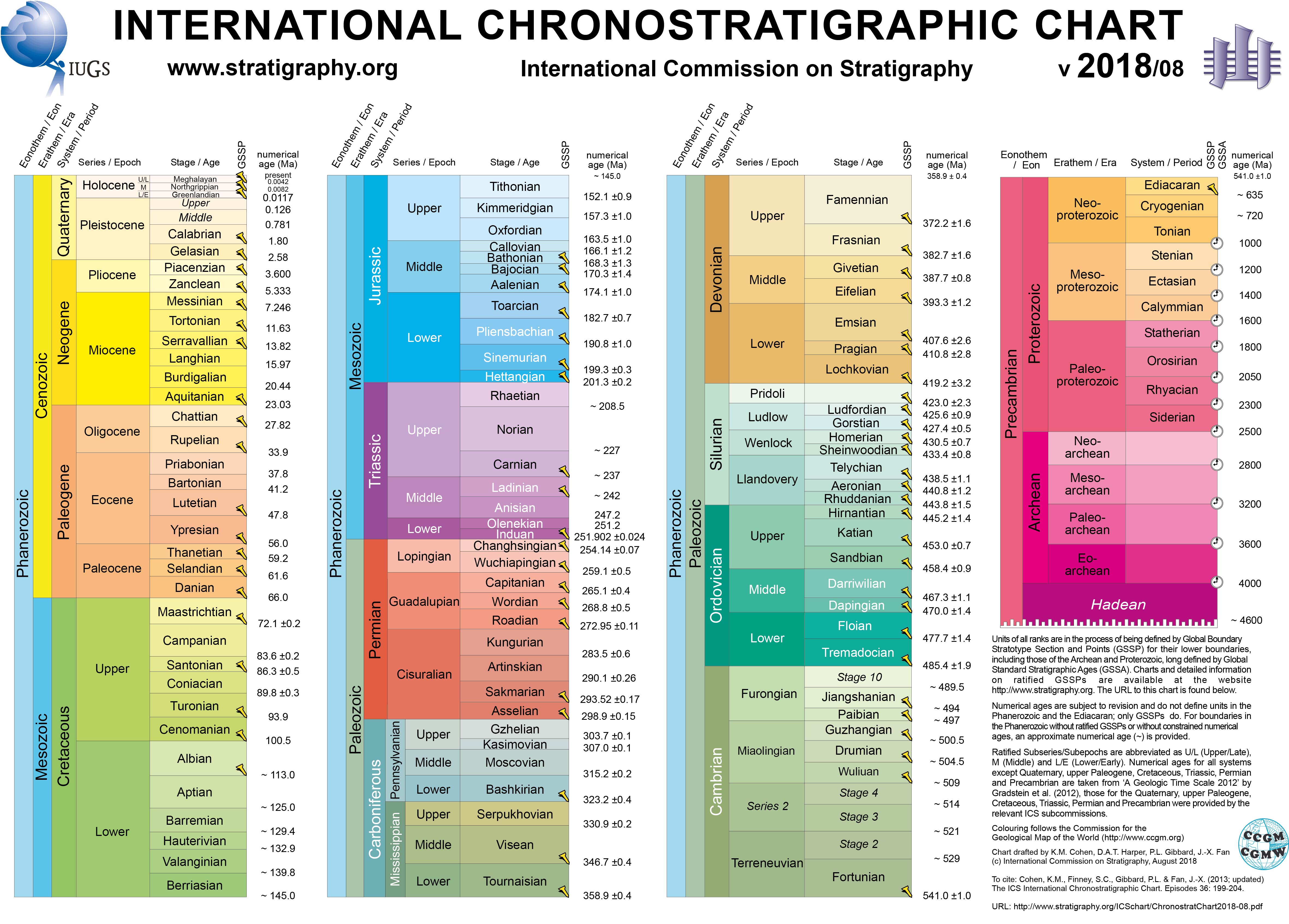
Period: Barremian of the early Cretaceous period, 129-125 million years ago.
Place: North America.
Length: 17-18 feet (5.2-5.6 meters).
Weight: 1 ton.
Specimens:
1. CEU 184v.86 (Holotype):
Length: 17 feet (5.2 meters).
Pedal Ungual II: 24 cm (Completed).
2. BYU 15465:
Length: 18 feet (5.6 meters).
Femur: 60 cm.
3. Unnamed Specimen with a 56.5-cm Femur:
Length: 17 feet (5.3 meters).
Femur: 56.5 cm.
Links:
Size:
https://psdinosaurs.blogspot.com/2018/12/utahraptor-facts.html
https://psdinosaurs.blogspot.com/2018/10/calculations-for-largest-theropods.html
Weight:
Asher Elbein (2017):
https://www.nytimes.com/2017/08/28/science/utah-paleontologists-turn-to-crowdfunding-for-raptor-project.html
Time:
International Chronostratigraphic Chart (2019 Version):
http://stratigraphy.org/ICSchart/ChronostratChart2019-05.jpg
Link 2:
http://stratigraphy.org/index.php/ics-chart-timescale
Thursday, December 20, 2018
Wednesday, December 19, 2018
Spinosaurus Specimen Sizes.
Name: Spinosaurus aegyptiacus.
Period: Albian-Cenomanian of the early-late Cretaceous period, 113-94 million years ago.
Length: 29-47 feet (8.8-14.2 meters).
Diet: Piscivore.
Specimens:
3. FSAC-KK 11888 (Neotype):
4. MHNM.KK378:
Length: 31 feet (9.5 meters).
Size:
https://psdinosaurs.blogspot.com/2018/10/calculations-for-largest-theropods.html
Link 2:
https://psdinosaurs.blogspot.com/2019/03/the-real-sizes-of-spinosaurs.html
Link 3:
https://psdinosaurs.blogspot.com/2017/09/spinosaurus-facts.html
Time Period:
https://psdinosaurs.blogspot.com/2017/09/spinosaurus-facts.html
Period: Albian-Cenomanian of the early-late Cretaceous period, 113-94 million years ago.
Length: 29-47 feet (8.8-14.2 meters).
Diet: Piscivore.
Specimens:
1. IPHG 1912 VIII 19 (Holotype):
Length: 34 feet (10.3 meters).
2. 1922 X 45 ("Spinosaurus B"):
Length: 31 feet (9.3 meters).
Length: 34 feet (10.3 meters).
Age: 17.
Age 18: 35 feet (10.7 meters)(?). (My estimate)
Skull Length: 123 cm.4. MHNM.KK378:
Length: 31 feet (9.5 meters).
Age: Adult.
Skull Length: 112.8 cm.
5. NHMUK VP R 16421: Length: 47 feet (14.2 meters).
6. MNHM SAM 124:
Links:Skull Length: 112.8 cm.
5. NHMUK VP R 16421: Length: 47 feet (14.2 meters).
6. MNHM SAM 124:
Size:
https://psdinosaurs.blogspot.com/2018/10/calculations-for-largest-theropods.html
Link 2:
https://psdinosaurs.blogspot.com/2019/03/the-real-sizes-of-spinosaurs.html
Link 3:
https://psdinosaurs.blogspot.com/2017/09/spinosaurus-facts.html
Time Period:
https://psdinosaurs.blogspot.com/2017/09/spinosaurus-facts.html
Saturday, December 15, 2018
Dino Bios: Mosasaurus.
Mosasaurus:
Time: 84-66 million years ago, Campanian-Maastricthian of the late Cretaceous period.
Place: North America and Europe.
Length: 27-51 feet (8.1-15.5 meters).
Diet: Carnivore.
This was one of the largest marine reptiles of all time!
Description:
Mosasaurus was a prehistoric marine reptile that lived 72-66 million years ago, during the Campanian-Maastricthian of the late Cretaceous period. It lived in North America and Europe. It was 27-51 feet (8.1-15.5 meters), and was one of the top predator of the seas and oceans during its time. The largest species, M. hoffmanni, was 51 feet (15.5 meters) long. It's only enemies were either its own species, or a genus of prehistoric shark called Squalicorax.
It had a cone-shaped head, serpentine-like body, four flippers, and a long tail. At the end of its tail, it had a shark-like (Lindgren et al., 2013) (Bob Yirka, 2013). It, along with other mosasaurs, are descendants of the small terrestrial lizard, Dallasaurus.
Mosasaur Tail Fluke (Bob Yirka, 2013):
Prey:
Mosasaurus hunted an assortment of prey, including sharks like Squalicorax and the predatory fish Xiphactinus, plesiosaurs like Hydrotherosaurus and others, and ammonites.
Links:
Length:
https://psdinosaurs.blogspot.com/2019/07/size-calculations-for-mosasaurs.html
Time:
Campanian:
North America:
Oceans of Kansas:
http://oceansofkansas.com/mus-mosa.html
Link 2:
http://oceansofkansas.com/Goldfuss.html
Europe:
Grigoriev (2014):
https://www.zin.ru/journals/trudyzin/doc/vol_318_2/TZ_318_2_Grigoriev.pdf
Dallasaurus:
Bell Jr. and Polcyn (2005):
https://www.researchgate.net/publication/27711031_Dallasaurus_turneri_a_new_primitive_mosasauroid_from_the_Middle_Turonian_of_Texas_and_comments_on_the_phylogeny_of_Mosasauridae_Squamata
ScienceDaily (2005):
https://www.sciencedaily.com/releases/2005/11/051116173945.htm
Prey:
Squalicorax:
Becker and Chamberlain, Jr. (2012):
https://www.mdpi.com/2076-3263/2/2/109/htm
Cretaceous Atlas of Ancient Life:
https://www.cretaceousatlas.org/species/squalicorax-pristodontus/
Xiphactinus:
Schwimmer et al., (1997):
https://www.jstor.org/stable/4523841?seq=1
Oceans of Kansas:
http://oceansofkansas.com/xiphac.html
Fossilworks:
http://fossilworks.org/bridge.pl?a=taxonInfo&taxon_no=35308
Hydrotherosaurus and Other Plesiosaurs:
Hydrotherosaurus:
Sven Sachs (2005):
https://www.researchgate.net/publication/262439623_Remarks_on_the_pectoral_girdle_of_Hydrotherosaurus_alexandrae_Plesiosauria_Elasmosauridae
Fossilworks:
http://fossilworks.org/?a=taxonInfo&taxon_no=199239
Elasmosaurus and Styxosaurus:
Kenneth Carpenter (1999) (Pg. 150 and 152; 158):
https://www.researchgate.net/profile/Kenneth_Carpenter3/publication/40662805_Revision_of_North_American_elasmosaurs_from_the_Cretaceous_of_the_Western_Interior/links/58c6e534a6fdccde55e3aec8/Revision-of-North-American-elasmosaurs-from-the-Cretaceous-of-the-Western-Interior.pdf
Fossilworks (Elasmosaurus):
http://fossilworks.org/bridge.pl?a=taxonInfo&taxon_no=36469
Fossilworks (Styxosaurus):
http://fossilworks.org/bridge.pl?a=taxonInfo&taxon_no=36516
Ammonites:
Kennedy et al., (2001):
https://www.sciencedirect.com/science/article/pii/S0195667101902459
Ifrim et al., (2005):
https://www.researchgate.net/publication/28080987_Maastrichtian_shallow-water_ammonites_of_northeastern_Mexico
Place: North America and Europe.
Length: 27-51 feet (8.1-15.5 meters).
Diet: Carnivore.
This was one of the largest marine reptiles of all time!
Description:
Mosasaurus was a prehistoric marine reptile that lived 72-66 million years ago, during the Campanian-Maastricthian of the late Cretaceous period. It lived in North America and Europe. It was 27-51 feet (8.1-15.5 meters), and was one of the top predator of the seas and oceans during its time. The largest species, M. hoffmanni, was 51 feet (15.5 meters) long. It's only enemies were either its own species, or a genus of prehistoric shark called Squalicorax.
It had a cone-shaped head, serpentine-like body, four flippers, and a long tail. At the end of its tail, it had a shark-like (Lindgren et al., 2013) (Bob Yirka, 2013). It, along with other mosasaurs, are descendants of the small terrestrial lizard, Dallasaurus.
Mosasaur Tail Fluke (Bob Yirka, 2013):
Prey:
Mosasaurus hunted an assortment of prey, including sharks like Squalicorax and the predatory fish Xiphactinus, plesiosaurs like Hydrotherosaurus and others, and ammonites.
Links:
Length:
https://psdinosaurs.blogspot.com/2019/07/size-calculations-for-mosasaurs.html
Time:
Campanian:
Takehito Ikejiri (2014):
https://www.researchgate.net/publication/271528820_Osteology_and_taxonomy_of_Mosasaurus_conodon_Cope_1881_from_the_Late_Cretaceous_of_North_America
Maastrichtian:https://www.researchgate.net/publication/271528820_Osteology_and_taxonomy_of_Mosasaurus_conodon_Cope_1881_from_the_Late_Cretaceous_of_North_America
Eric Mulder (1999):
https://www.researchgate.net/publication/262901771_Transatlantic_latest_Cretaceous_Mosasaurs_Reptilia_Lacertilia_from_the_Maastrichtian_type_area_and_New_Jersey
Harrell and Martin (2014):
https://geology.rutgers.edu/images/stories/faculty/miller_kenneth_g/kgmpdf/12-Gallagher.GeolFrance.pdf
James E. Martin (2006):
"Abstract":
https://sp.lyellcollection.org/content/258/1/101
Full Text:
James E. Martin (2006):
"Abstract":
https://sp.lyellcollection.org/content/258/1/101
Full Text:
International Chronostratigraphic Chart (2020):
International Commission of Stratigraphy Website:
Tail Fin:
Lindgren et al., (2013):
https://www.nature.com/articles/ncomms3423
Bob Yirka (2013):
https://phys.org/news/2013-09-mosasaur-fossil-early-lizards-tails.html
Locations:Lindgren et al., (2013):
https://www.nature.com/articles/ncomms3423
Bob Yirka (2013):
https://phys.org/news/2013-09-mosasaur-fossil-early-lizards-tails.html
North America:
Oceans of Kansas:
http://oceansofkansas.com/mus-mosa.html
Link 2:
http://oceansofkansas.com/Goldfuss.html
Europe:
Grigoriev (2014):
https://www.zin.ru/journals/trudyzin/doc/vol_318_2/TZ_318_2_Grigoriev.pdf
Dallasaurus:
Bell Jr. and Polcyn (2005):
https://www.researchgate.net/publication/27711031_Dallasaurus_turneri_a_new_primitive_mosasauroid_from_the_Middle_Turonian_of_Texas_and_comments_on_the_phylogeny_of_Mosasauridae_Squamata
ScienceDaily (2005):
https://www.sciencedaily.com/releases/2005/11/051116173945.htm
Prey:
Squalicorax:
Becker and Chamberlain, Jr. (2012):
https://www.mdpi.com/2076-3263/2/2/109/htm
Cretaceous Atlas of Ancient Life:
https://www.cretaceousatlas.org/species/squalicorax-pristodontus/
Xiphactinus:
Schwimmer et al., (1997):
https://www.jstor.org/stable/4523841?seq=1
Oceans of Kansas:
http://oceansofkansas.com/xiphac.html
Fossilworks:
http://fossilworks.org/bridge.pl?a=taxonInfo&taxon_no=35308
Hydrotherosaurus and Other Plesiosaurs:
Hydrotherosaurus:
Sven Sachs (2005):
https://www.researchgate.net/publication/262439623_Remarks_on_the_pectoral_girdle_of_Hydrotherosaurus_alexandrae_Plesiosauria_Elasmosauridae
Fossilworks:
http://fossilworks.org/?a=taxonInfo&taxon_no=199239
Elasmosaurus and Styxosaurus:
Kenneth Carpenter (1999) (Pg. 150 and 152; 158):
https://www.researchgate.net/profile/Kenneth_Carpenter3/publication/40662805_Revision_of_North_American_elasmosaurs_from_the_Cretaceous_of_the_Western_Interior/links/58c6e534a6fdccde55e3aec8/Revision-of-North-American-elasmosaurs-from-the-Cretaceous-of-the-Western-Interior.pdf
Fossilworks (Elasmosaurus):
http://fossilworks.org/bridge.pl?a=taxonInfo&taxon_no=36469
Fossilworks (Styxosaurus):
http://fossilworks.org/bridge.pl?a=taxonInfo&taxon_no=36516
Ammonites:
Kennedy et al., (2001):
https://www.sciencedirect.com/science/article/pii/S0195667101902459
Ifrim et al., (2005):
https://www.researchgate.net/publication/28080987_Maastrichtian_shallow-water_ammonites_of_northeastern_Mexico
Dino Bios: Titanoboa.
Titanoboa (From Titanoboa: Monster Snake):
Time: 66-56 million years ago, Paleocene Epoch of the Paleogene period.
Place: South America.
Length: 45 feet (13.7 meters).
Diet: Carnivore.
This is the largest species of snake that ever slithered across the Earth!
Description:
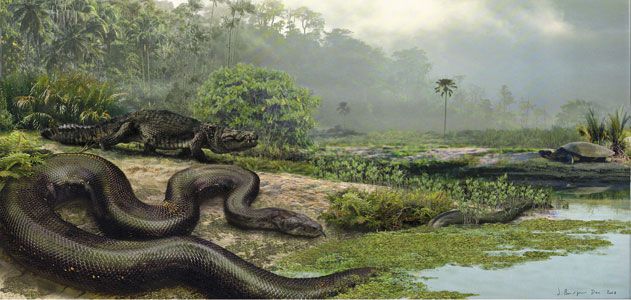
Titanoboa is a boid (constrictor) snake that lived during the Paleocene Epoch of the Paleogene period 66-56 million years ago, during the Paleocene Epoch. It was discovered in the Cerrejon Formation in South America, and it was the largest species of snake that ever lived. It was 45 feet (13.7 meters) long, had had a 40-cm skull. It is described as being "anaconda-like" (Head et al., 2009, "Abstract"), which makes sense because both Titanoboa and the anaconda lived/live in South America. Like other boas, Titanoboa would have killed its prey by constriction.
Prey:
Titanoboa was the largest predator in its environment. It lived around the giant turtle Carbonemys, and the large dyrosaurid Acherontisuchus.
Cerrejon Formation Animals:
Links:
Head et al., (2009):
https://www.researchgate.net/publication/23980887_Giant_boid_snake_from_the_Palaeocene_neotropics_reveals_hotter_past_equatorial_temperatures
https://medical-dictionary.thefreedictionary.com/boid+snake
Carbonemys:
https://phys.org/news/2012-05-reveal-ancient-giant-turtle-fossil.html
Acherontisuchus:
https://www.science20.com/science_20/acherontisuchus_guajiraensis_prehistoric_giant_crocodile_versus_worlds_largest_snake-82630
International Commission of Stratigraphy Website:
https://stratigraphy.org/news/130
Time: 66-56 million years ago, Paleocene Epoch of the Paleogene period.
Place: South America.
Length: 45 feet (13.7 meters).
Diet: Carnivore.
This is the largest species of snake that ever slithered across the Earth!
Description:
Titanoboa is a boid (constrictor) snake that lived during the Paleocene Epoch of the Paleogene period 66-56 million years ago, during the Paleocene Epoch. It was discovered in the Cerrejon Formation in South America, and it was the largest species of snake that ever lived. It was 45 feet (13.7 meters) long, had had a 40-cm skull. It is described as being "anaconda-like" (Head et al., 2009, "Abstract"), which makes sense because both Titanoboa and the anaconda lived/live in South America. Like other boas, Titanoboa would have killed its prey by constriction.
Prey:
Titanoboa was the largest predator in its environment. It lived around the giant turtle Carbonemys, and the large dyrosaurid Acherontisuchus.
Cerrejon Formation Animals:
Links:
Head et al., (2009):
https://www.researchgate.net/publication/23980887_Giant_boid_snake_from_the_Palaeocene_neotropics_reveals_hotter_past_equatorial_temperatures
Head et al., (2013):
Boid (Boidae):https://medical-dictionary.thefreedictionary.com/boid+snake
Carbonemys:
https://phys.org/news/2012-05-reveal-ancient-giant-turtle-fossil.html
Acherontisuchus:
https://www.science20.com/science_20/acherontisuchus_guajiraensis_prehistoric_giant_crocodile_versus_worlds_largest_snake-82630
International Chronostratigraphic Chart (2020):
https://stratigraphy.org/timescale/International Commission of Stratigraphy Website:
https://stratigraphy.org/news/130
Friday, December 7, 2018
Dino Bios: Otodus megalodon.
O. megalodon:
Time: 23-5.3 million years ago, Miocene Epoch of the Neogene period.
Place: Worldwide.
Length: 52-72 feet (15.7-21.8 meters).
Diet: Carnivore.
This is largest species of shark that ever lived, and my favorite prehistoric shark!
Description:
Otodus megalodon (O. megalodon, or commonly known as "Megalodon") was the largest species of shark that had ever existed (Hall, 2019, "Anatomy": "A Big Shark" p. 1). At best, it lived during the Miocene (Pimiento et al., 2016, "Abstract": "Location") (Boessenecker et al., 2019, "Abstract"), and its maximum size was up to 52-72 feet long (15.7-21.8 meters). This animal has had many names: Carcharodon megalodon (Nyberg et al., 2006, "Abstract"), Carcharocles megalodon (Pimiento et al., 2016, "Abstract"), and now Otodus megalodon (Boessenecker et al., 2019, "Abstract"). To the general public, it's known simply as "Megalodon." This shark lived worldwide (Hideo et al., 2004, "Abstract") (Pimiento et al., 2016, "Abstract": "Location").
O. megalodon was closely related to the Whale Shark, not the Great White (Hall, 2019, "Anatomy": "A Big Shark" p. 2). O. megalodon didn't look like a Great White either (Davis, "What did megalodon look like?" p. 1-3). It had "a much shorter nose, or rostrum, when compared with the great white, with a flatter, almost squashed jaw. Like the blue shark, it also had extra-long pectoral fins to support its weight and size," (Davis, "What did megalodon look like?" p. 2).
Prey and Enemies:
O. megalodon co-existed with prehistoric whales. One species of whale it hunted was a baleen whale called Cetotherium (Gol'Din et al., 2014). However, O. megalodon's main source of prey, and enemy, is the larger prehistoric sperm whale known as Livyatan. It was 49-60 feet long (15.0-18.4 meters).
O. megalodon Hunting (?)Cetotherium:
Extinction:
Scientists say that O. megalodon became extinct due to the appearance, and competition, of the smaller Great White Shark (Boessenecker et al., 2019, "Abstract") (Gander, 2019) (Davis, "What did megalodon look like?" p. 5). Smaller sharks need less food to survive, but larger sharks need more. The competition from the great white seems to have caused O. megalodon to die out from starvation.
Links:
Size:
https://psdinosaurs.blogspot.com/2019/07/size-calculations-for-megalodon.html
Hall (2019) ("Anatomy": "A Big Shark" p. 1):
https://ocean.si.edu/ocean-life/sharks-rays/megalodon
Time:
Boessenecker et al., (2019) ("Abstract"):
https://www.ncbi.nlm.nih.gov/pmc/articles/PMC6377595/
Link 2:
https://peerj.com/articles/6088/
Pimiento et al., (2016) ("Abstract": "Location"):
https://onlinelibrary.wiley.com/doi/full/10.1111/jbi.12754
International Commission of Stratigraphy Website:
https://stratigraphy.org/news/130
Location:
Pimiento et al., (2016) ("Abstract": "Location"):
https://onlinelibrary.wiley.com/doi/full/10.1111/jbi.12754
Hideo et al., (2004) ("Abstract"):
https://ci.nii.ac.jp/naid/110007574397/en
Naming:
Boessenecker et al., (2019) ("Abstract"):
https://www.ncbi.nlm.nih.gov/pmc/articles/PMC6377595/
Link 2:
https://peerj.com/articles/6088/
Pimiento et al., (2016) ("Abstract"):
https://onlinelibrary.wiley.com/doi/full/10.1111/jbi.12754
Nyberg et al., (2006) ("Abstract"):
https://www.tandfonline.com/doi/abs/10.1671/0272-4634%282006%2926%5B806%3ATTAOTG%5D2.0.CO%3B2
Description:
Davis ("What did megalodon look like?"):
https://www.nhm.ac.uk/discover/megalodon--the-truth-about-the-largest-shark-that-ever-lived.html
Prey:
Cetotherium:
Gol'Din et al., (2014):
https://www.app.pan.pl/archive/published/app59/app20120107.pdf
Picture:
https://www.earthtouchnews.com/discoveries/fossils/bite-marks-provide-clues-to-megalodons-diet-and-extinction/
Livyathan:
https://psdinosaurs.blogspot.com/2019/08/size-calculations-for-livyathan.html
Extinction:
Gander (2019):
https://www.newsweek.com/megalodon-world-biggest-shark-extinct-great-white-1331115
Boessenecker et al., (2019) ("Abstract"):
https://www.ncbi.nlm.nih.gov/pmc/articles/PMC6377595/
Link 2:
https://peerj.com/articles/6088/
Davis ("What did megalodon look like?" p. 5):
https://www.nhm.ac.uk/discover/megalodon--the-truth-about-the-largest-shark-that-ever-lived.html
Time: 23-5.3 million years ago, Miocene Epoch of the Neogene period.
Place: Worldwide.
Length: 52-72 feet (15.7-21.8 meters).
Diet: Carnivore.
This is largest species of shark that ever lived, and my favorite prehistoric shark!
Description:
Otodus megalodon (O. megalodon, or commonly known as "Megalodon") was the largest species of shark that had ever existed (Hall, 2019, "Anatomy": "A Big Shark" p. 1). At best, it lived during the Miocene (Pimiento et al., 2016, "Abstract": "Location") (Boessenecker et al., 2019, "Abstract"), and its maximum size was up to 52-72 feet long (15.7-21.8 meters). This animal has had many names: Carcharodon megalodon (Nyberg et al., 2006, "Abstract"), Carcharocles megalodon (Pimiento et al., 2016, "Abstract"), and now Otodus megalodon (Boessenecker et al., 2019, "Abstract"). To the general public, it's known simply as "Megalodon." This shark lived worldwide (Hideo et al., 2004, "Abstract") (Pimiento et al., 2016, "Abstract": "Location").
O. megalodon was closely related to the Whale Shark, not the Great White (Hall, 2019, "Anatomy": "A Big Shark" p. 2). O. megalodon didn't look like a Great White either (Davis, "What did megalodon look like?" p. 1-3). It had "a much shorter nose, or rostrum, when compared with the great white, with a flatter, almost squashed jaw. Like the blue shark, it also had extra-long pectoral fins to support its weight and size," (Davis, "What did megalodon look like?" p. 2).
Prey and Enemies:
O. megalodon co-existed with prehistoric whales. One species of whale it hunted was a baleen whale called Cetotherium (Gol'Din et al., 2014). However, O. megalodon's main source of prey, and enemy, is the larger prehistoric sperm whale known as Livyatan. It was 49-60 feet long (15.0-18.4 meters).
O. megalodon Hunting (?)Cetotherium:
Extinction:
Scientists say that O. megalodon became extinct due to the appearance, and competition, of the smaller Great White Shark (Boessenecker et al., 2019, "Abstract") (Gander, 2019) (Davis, "What did megalodon look like?" p. 5). Smaller sharks need less food to survive, but larger sharks need more. The competition from the great white seems to have caused O. megalodon to die out from starvation.
Links:
Size:
https://psdinosaurs.blogspot.com/2019/07/size-calculations-for-megalodon.html
Hall (2019) ("Anatomy": "A Big Shark" p. 1):
https://ocean.si.edu/ocean-life/sharks-rays/megalodon
Time:
Boessenecker et al., (2019) ("Abstract"):
https://www.ncbi.nlm.nih.gov/pmc/articles/PMC6377595/
Link 2:
https://peerj.com/articles/6088/
Pimiento et al., (2016) ("Abstract": "Location"):
https://onlinelibrary.wiley.com/doi/full/10.1111/jbi.12754
International Chronostratigraphic Chart (2020):
https://stratigraphy.org/timescale/International Commission of Stratigraphy Website:
https://stratigraphy.org/news/130
Location:
Pimiento et al., (2016) ("Abstract": "Location"):
https://onlinelibrary.wiley.com/doi/full/10.1111/jbi.12754
Hideo et al., (2004) ("Abstract"):
https://ci.nii.ac.jp/naid/110007574397/en
Naming:
Boessenecker et al., (2019) ("Abstract"):
https://www.ncbi.nlm.nih.gov/pmc/articles/PMC6377595/
Link 2:
https://peerj.com/articles/6088/
Pimiento et al., (2016) ("Abstract"):
https://onlinelibrary.wiley.com/doi/full/10.1111/jbi.12754
Nyberg et al., (2006) ("Abstract"):
https://www.tandfonline.com/doi/abs/10.1671/0272-4634%282006%2926%5B806%3ATTAOTG%5D2.0.CO%3B2
Description:
Davis ("What did megalodon look like?"):
https://www.nhm.ac.uk/discover/megalodon--the-truth-about-the-largest-shark-that-ever-lived.html
Prey:
Cetotherium:
Gol'Din et al., (2014):
https://www.app.pan.pl/archive/published/app59/app20120107.pdf
Picture:
https://www.earthtouchnews.com/discoveries/fossils/bite-marks-provide-clues-to-megalodons-diet-and-extinction/
Livyathan:
https://psdinosaurs.blogspot.com/2019/08/size-calculations-for-livyathan.html
Extinction:
Gander (2019):
https://www.newsweek.com/megalodon-world-biggest-shark-extinct-great-white-1331115
Boessenecker et al., (2019) ("Abstract"):
https://www.ncbi.nlm.nih.gov/pmc/articles/PMC6377595/
Link 2:
https://peerj.com/articles/6088/
Davis ("What did megalodon look like?" p. 5):
https://www.nhm.ac.uk/discover/megalodon--the-truth-about-the-largest-shark-that-ever-lived.html
Wednesday, December 5, 2018
Dino Bios: Utahraptor.
Place: North America.
Length: 17-18 feet (5.2-5.6 meters).Weight: 1 ton.
Diet: Carnivore.
Say hello to the largest raptor that has ever lived!
Description:
Utahraptor was the largest and heaviest dromaeosaurid to have ever lived, at 17-18 feet long (5.2-5.6 meters) and weighing up to a ton (Asher Elbein, 2017, p. 4). The specimen CEU 184v.260 is 15 feet long. A 2016 adult individual, found with a pack, was 16 feet long. The holotype, CEU 184v.86, consists of a large sickle claw (pedal ungual II), the largest one ever discovered for the species (Kirkland et al., 1993, pg. 5). It is 22 centimeters long, but it is not complete. In total length, it would have measured 24 cm (Kirkland et al., 1993, pg. 10). Based on Dakotaraptor's 24-cm pedal ungual II (DePalma et al., 2015, pg. 10), CEU 184v.86 would be 18 feet, the same size as the Dakotaraptor holotype. Another specimen with a 56.5-cm femur also measures 18 feet as well. The largest recorded specimen is BYU 15465, at 19 feet long. Its femur is 60.0 cm long.
Carnivorous theropod dinosaurs had enamel in their teeth, so they must have had lips to cover and protect their teeth (Reisz and Larson, 2016, pg. 64-66) (Blake Eligh, 2016) (Mindy Weisberger, 2016) (Emanuela Grinberg, 2016) (Phys, 2016). Therefore, Utahraptor would have had lips covering its teeth. Interestingly, dinosaurs couldn't move its tongues (Mindy Weisberger, 2018) (ScienceDaily, 2018).
Utahraptor was also heavier and stockier than later raptors such as Dakotaraptor, which were more slender. Its tail was also shorter and more flexible than other dromeosaurs as well (Scott Hartman, 2017, p. 4).
According to Kenneth Carpenter (2002), in most predatory theropods used their mouths first to grab prey first, and then they would grab their prey "in a 'bear hug'" with their hands (pg. 72, "Conclusion"). Surprisingly, this might not have been true for dromeosaurs. In Deinonychus, it would have used its arms to grab prey first, and then use the sickle claws on its feet to slice its prey open (pg. 68, "Biomechanical Analysis"). Text-figure 9 shows Deinonychus', and other theropod's, range of motion for their hands (pg. 69). This method of attacking prey, by using hands for grabbing and feet for slashing, seems to have been what Utahraptor did as well.
As for how Utahraptor's hands were positioned casually, this is shown in Senter and Robins (2015) for Velociraptor (Figure 5 "B"; Figure 4 "B"). This would have been true for Utahraptor.
Dromaeosaur Hand Design (Senter and Robins, 2015, Figure 5, "B"):
Time:
As for its time period, it was originally though that Utahraptor lived in the Barremian (Kirkland et a;., 1993, pg. 5), which is 129-125 million years ago, according to the International Chronostratigraphic Chart (2019 Version). Then it was suggested that it lived in the Aptian (Kirkland et al., 2016, pg. 1-2, "Geological Setting") (Senter et al., 2012, pg. 4, "Geological Setting"). This is due to the fact that the Yellow Cat Member of the Cedar Formation, where Utahraptor was discovered, is now divided into two sections: the "lower" and "upper" parts. The lower part of the Yellow Cat Member is Barremian, while the "upper" part is Aptian (Senter et al., 2012, pg. 4, "Geological Setting"). Utahraptor is from the upper part (Kirkland et al., 2016, pg. 1-2, "Geological Setting"). Now, Utahraptor's time period has been pushed even further back into the Cretaceous. The entire Yellow Cat Member has now been dated to 143-130 million years ago (Milan et al., 2015, pg. 516, "Geological Setting") (Joeckel et al., 2019, "Abstract"). According to the International Chronostratigraphic Chart (2019 Version), this places Utahraptor in the Berriasian-Hauterivian of the early Cretaceous period, which is 145-129 million years ago.
Prey:
Utahraptor hunted the ankylosaur Gastonia, and hadrosaurs like Cedrorestes and the larger Iguanacolossus. It probably also hunted the young of the sauropod Cedarosaurus.
Links:
Original Paper:
Kirkland et al., (1993):
https://www.academia.edu/225747/A_large_dromaeosaurid_Theropoda_from_the_Lower_Cretaceous_of_Eastern_Utah
Time:
Joeckel et al., (2019) ("Abstract"):
https://sp.lyellcollection.org/content/498/1/75
Milan et al., (2015) (Pg. 516, "Geological Setting"):
https://geojournals.pgi.gov.pl/asgp/article/view/24870/17008
Link 2:
https://geojournals.pgi.gov.pl/asgp/article/view/24870
Senter et al., (2012) (Pg. 4, "Geological Setting"):
https://www.ncbi.nlm.nih.gov/pmc/articles/PMC3352940/
Kirkland et a., (2016) (Pg. 1-2, "Geological Setting"):
https://www.researchgate.net/publication/308041652_Depositional_constraints_on_the_Lower_Cretaceous_stikes_quarry_dinosaur_site_Upper_yellow_cat_member_cedar_mountain_formation_Utah
Kirkland et al., (1993) (Pg. 5):
https://www.academia.edu/225747/A_large_dromaeosaurid_Theropoda_from_the_Lower_Cretaceous_of_Eastern_Utah
International Commission of Stratigraphy Website:
https://stratigraphy.org/news/130
Size:
https://psdinosaurs.blogspot.com/2018/10/calculations-for-largest-theropods.html
Weight:
Asher Elbein (2017) (P. 4):
https://www.nytimes.com/2017/08/28/science/utah-paleontologists-turn-to-crowdfunding-for-raptor-project.html
Lips:
Reisz and Larson (2016) (Pg. 64-66):
https://cansvp.files.wordpress.com/2013/08/csvp-2016-abstract-book-compressed.pdf
Blake Eligh (2016):
https://www.utoronto.ca/news/did-dinosaurs-have-lips-ask-university-toronto-paleontologist
Mindy Weisberger (2016):
https://www.livescience.com/54912-did-t-rex-have-lips.html
Emanuela Grinberg (2016):
https://www.cnn.com/2016/05/22/world/dinosaur-lips-teeth-study/index.html
Phys (2016):
https://phys.org/news/2016-06-dinosaurs-lips.html
Tongue:
Mindy Weisberger (2018):
https://www.scientificamerican.com/article/t-rex-couldnt-stick-out-its-tongue/
ScienceDaily (2018):
https://www.sciencedaily.com/releases/2018/06/180620150129.htm
Hands:
Kenneth Carpenter (2002):
https://www.researchgate.net/publication/225366451_Forelimb_biomechanics_of_nonavian_theropod_dinosaurs_in_predation
Senter and Robins (2015):
https://journals.plos.org/plosone/article?id=10.1371/journal.pone.0144036
Body Design:
Scott Hartman (2017):
http://www.skeletaldrawing.com/home/at-long-last-utahraptor
Prey:
Gastonia:
https://psdinosaurs.blogspot.com/2018/12/size-calculations-for-herbivorous.html
Iguanacolossus:
https://psdinosaurs.blogspot.com/2018/12/size-calculations-for-herbivorous.html
Cedarosaurus:
https://psdinosaurs.blogspot.com/2018/12/size-calculations-for-herbivorous.html
Cedrorestes:
https://psdinosaurs.blogspot.com/2018/12/size-calculations-for-herbivorous.html
Say hello to the largest raptor that has ever lived!
Description:
Utahraptor was the largest and heaviest dromaeosaurid to have ever lived, at 17-18 feet long (5.2-5.6 meters) and weighing up to a ton (Asher Elbein, 2017, p. 4). The specimen CEU 184v.260 is 15 feet long. A 2016 adult individual, found with a pack, was 16 feet long. The holotype, CEU 184v.86, consists of a large sickle claw (pedal ungual II), the largest one ever discovered for the species (Kirkland et al., 1993, pg. 5). It is 22 centimeters long, but it is not complete. In total length, it would have measured 24 cm (Kirkland et al., 1993, pg. 10). Based on Dakotaraptor's 24-cm pedal ungual II (DePalma et al., 2015, pg. 10), CEU 184v.86 would be 18 feet, the same size as the Dakotaraptor holotype. Another specimen with a 56.5-cm femur also measures 18 feet as well. The largest recorded specimen is BYU 15465, at 19 feet long. Its femur is 60.0 cm long.
Carnivorous theropod dinosaurs had enamel in their teeth, so they must have had lips to cover and protect their teeth (Reisz and Larson, 2016, pg. 64-66) (Blake Eligh, 2016) (Mindy Weisberger, 2016) (Emanuela Grinberg, 2016) (Phys, 2016). Therefore, Utahraptor would have had lips covering its teeth. Interestingly, dinosaurs couldn't move its tongues (Mindy Weisberger, 2018) (ScienceDaily, 2018).
Utahraptor was also heavier and stockier than later raptors such as Dakotaraptor, which were more slender. Its tail was also shorter and more flexible than other dromeosaurs as well (Scott Hartman, 2017, p. 4).
According to Kenneth Carpenter (2002), in most predatory theropods used their mouths first to grab prey first, and then they would grab their prey "in a 'bear hug'" with their hands (pg. 72, "Conclusion"). Surprisingly, this might not have been true for dromeosaurs. In Deinonychus, it would have used its arms to grab prey first, and then use the sickle claws on its feet to slice its prey open (pg. 68, "Biomechanical Analysis"). Text-figure 9 shows Deinonychus', and other theropod's, range of motion for their hands (pg. 69). This method of attacking prey, by using hands for grabbing and feet for slashing, seems to have been what Utahraptor did as well.
As for how Utahraptor's hands were positioned casually, this is shown in Senter and Robins (2015) for Velociraptor (Figure 5 "B"; Figure 4 "B"). This would have been true for Utahraptor.
Dromaeosaur Hand Design (Senter and Robins, 2015, Figure 5, "B"):
As for its time period, it was originally though that Utahraptor lived in the Barremian (Kirkland et a;., 1993, pg. 5), which is 129-125 million years ago, according to the International Chronostratigraphic Chart (2019 Version). Then it was suggested that it lived in the Aptian (Kirkland et al., 2016, pg. 1-2, "Geological Setting") (Senter et al., 2012, pg. 4, "Geological Setting"). This is due to the fact that the Yellow Cat Member of the Cedar Formation, where Utahraptor was discovered, is now divided into two sections: the "lower" and "upper" parts. The lower part of the Yellow Cat Member is Barremian, while the "upper" part is Aptian (Senter et al., 2012, pg. 4, "Geological Setting"). Utahraptor is from the upper part (Kirkland et al., 2016, pg. 1-2, "Geological Setting"). Now, Utahraptor's time period has been pushed even further back into the Cretaceous. The entire Yellow Cat Member has now been dated to 143-130 million years ago (Milan et al., 2015, pg. 516, "Geological Setting") (Joeckel et al., 2019, "Abstract"). According to the International Chronostratigraphic Chart (2019 Version), this places Utahraptor in the Berriasian-Hauterivian of the early Cretaceous period, which is 145-129 million years ago.
Prey:
Utahraptor hunted the ankylosaur Gastonia, and hadrosaurs like Cedrorestes and the larger Iguanacolossus. It probably also hunted the young of the sauropod Cedarosaurus.
Links:
Original Paper:
Kirkland et al., (1993):
https://www.academia.edu/225747/A_large_dromaeosaurid_Theropoda_from_the_Lower_Cretaceous_of_Eastern_Utah
Time:
Joeckel et al., (2019) ("Abstract"):
https://sp.lyellcollection.org/content/498/1/75
Milan et al., (2015) (Pg. 516, "Geological Setting"):
https://geojournals.pgi.gov.pl/asgp/article/view/24870/17008
Link 2:
https://geojournals.pgi.gov.pl/asgp/article/view/24870
Senter et al., (2012) (Pg. 4, "Geological Setting"):
https://www.ncbi.nlm.nih.gov/pmc/articles/PMC3352940/
Kirkland et a., (2016) (Pg. 1-2, "Geological Setting"):
https://www.researchgate.net/publication/308041652_Depositional_constraints_on_the_Lower_Cretaceous_stikes_quarry_dinosaur_site_Upper_yellow_cat_member_cedar_mountain_formation_Utah
Kirkland et al., (1993) (Pg. 5):
https://www.academia.edu/225747/A_large_dromaeosaurid_Theropoda_from_the_Lower_Cretaceous_of_Eastern_Utah
International Chronostratigraphic Chart (2020):
https://stratigraphy.org/timescale/International Commission of Stratigraphy Website:
https://stratigraphy.org/news/130
Size:
https://psdinosaurs.blogspot.com/2018/10/calculations-for-largest-theropods.html
Weight:
Asher Elbein (2017) (P. 4):
https://www.nytimes.com/2017/08/28/science/utah-paleontologists-turn-to-crowdfunding-for-raptor-project.html
Lips:
Reisz and Larson (2016) (Pg. 64-66):
https://cansvp.files.wordpress.com/2013/08/csvp-2016-abstract-book-compressed.pdf
Blake Eligh (2016):
https://www.utoronto.ca/news/did-dinosaurs-have-lips-ask-university-toronto-paleontologist
Mindy Weisberger (2016):
https://www.livescience.com/54912-did-t-rex-have-lips.html
Emanuela Grinberg (2016):
https://www.cnn.com/2016/05/22/world/dinosaur-lips-teeth-study/index.html
Phys (2016):
https://phys.org/news/2016-06-dinosaurs-lips.html
Tongue:
Mindy Weisberger (2018):
https://www.scientificamerican.com/article/t-rex-couldnt-stick-out-its-tongue/
ScienceDaily (2018):
https://www.sciencedaily.com/releases/2018/06/180620150129.htm
Hands:
Kenneth Carpenter (2002):
https://www.researchgate.net/publication/225366451_Forelimb_biomechanics_of_nonavian_theropod_dinosaurs_in_predation
Senter and Robins (2015):
https://journals.plos.org/plosone/article?id=10.1371/journal.pone.0144036
Body Design:
Scott Hartman (2017):
http://www.skeletaldrawing.com/home/at-long-last-utahraptor
Prey:
Gastonia:
https://psdinosaurs.blogspot.com/2018/12/size-calculations-for-herbivorous.html
Iguanacolossus:
https://psdinosaurs.blogspot.com/2018/12/size-calculations-for-herbivorous.html
Cedarosaurus:
https://psdinosaurs.blogspot.com/2018/12/size-calculations-for-herbivorous.html
Cedrorestes:
https://psdinosaurs.blogspot.com/2018/12/size-calculations-for-herbivorous.html
Sunday, December 2, 2018
Giganotosaurus Specimen Sizes.
1. First Species:
Name: Giganotosaurus carolinii.
Period: Albian-early Turonian of the early-late Cretaceous period, 108-92 million years ago.
Place: South America.
Length: 41-43 feet (12.4-13.1 meters).
Diet: Carnivore.
Specimens:
1. MUCPv-CH 1 (Holotype):
2. Second Species:
Name: Mapusaurus/Giganotosaurus roseae.
Period: Turonian-late Santonian of the late Cretaceous period, 92-84.1 million years ago.
Place: South America.
Length: 36-50 feet (10.9-15.3 meters).
Diet: Carnivore.
Specimens:
1. MCF-PVPH-108.1 (Holotype):
Length: Unknown. Not enough material.
Material: A right nasal (Coria and Currie, 2006, pp. 75 and 78).
2. MCF-PVPH-108.234:
Length: 40 feet (12.2 meters).
Femur: 130 cm.
3. MCF-PVPH-108.45:
Length: 36 feet (10.9 meters).
Femur: 118.0 cm.
4. MCF-PVPH-108.202:
Length: 50 feet (15.3 meters).
Fibula: 104 cm.
5. MCF-PVPH-108.203:
Length: 42 feet (12.7 meters).
Femur: 134 cm.
6. MCF-PVPH-108.68:
Length: 40 feet (12.1 meters).
Tibia: 110 cm.
7. MCF-PVPH-108.145:
Length: 45 feet (13.6 meters).
Mapusaurus/Giganotosaurus roseae Skeletons (Nagoya City Science Museum):
Length:
https://psdinosaurs.blogspot.com/2018/10/calculations-for-largest-theropods.html
Time:
Name: Giganotosaurus carolinii.
Period: Albian-early Turonian of the early-late Cretaceous period, 108-92 million years ago.
Place: South America.
Length: 41-43 feet (12.4-13.1 meters).
Diet: Carnivore.
Specimens:
1. MUCPv-CH 1 (Holotype):
Length: 41 feet (12.4 meters).
Dentary: 56 cm.
Femur: 132.5 cm.
Skull: 149.8 cm.
Femur: 132.5 cm.
Skull: 149.8 cm.
Length: 43 feet (13.1 meters).
Dentary: 59 cm.
Skull: Skull: 157.9 cm.
MUCPv-95 (Calvo and Coria, 1998):
3. MUCPv-52:
Material: Only a tooth.
Size: Unknown.
4. Scattered teeth from all over the Candeleros Formation.
Links:
MUCPv-CH 1:
Size:
https://psdinosaurs.blogspot.com/2018/10/how-big-was-mucpv-95.html
Link 2:
https://psdinosaurs.blogspot.com/2018/10/calculations-for-largest-theropods.html
MUCPv-95:
https://psdinosaurs.blogspot.com/2018/10/how-big-was-mucpv-95.html
Link 2:
https://psdinosaurs.blogspot.com/2018/10/calculations-for-largest-theropods.html
MUCPv-52:
Calvo (1999) (Pg. 26):
https://www.researchgate.net/publication/284053211_Dinosaurs_and_other_vertebrates_of_the_Lake_Ezequiel_Ramos_Mexia_Area_Neuquen-Patagonia_Argentina
Teeth:
Theropod Database:
http://theropoddatabase.com/Carnosauria.htm#Giganotosauruscarolinii
Time Period:
https://psdinosaurs.blogspot.com/2017/09/giganotosaurus-facts.html
Skull: Skull: 157.9 cm.
MUCPv-95 (Calvo and Coria, 1998):
3. MUCPv-52:
Material: Only a tooth.
Size: Unknown.
4. Scattered teeth from all over the Candeleros Formation.
Links:
MUCPv-CH 1:
Size:
https://psdinosaurs.blogspot.com/2018/10/how-big-was-mucpv-95.html
Link 2:
https://psdinosaurs.blogspot.com/2018/10/calculations-for-largest-theropods.html
MUCPv-95:
https://psdinosaurs.blogspot.com/2018/10/how-big-was-mucpv-95.html
Link 2:
https://psdinosaurs.blogspot.com/2018/10/calculations-for-largest-theropods.html
MUCPv-52:
Calvo (1999) (Pg. 26):
https://www.researchgate.net/publication/284053211_Dinosaurs_and_other_vertebrates_of_the_Lake_Ezequiel_Ramos_Mexia_Area_Neuquen-Patagonia_Argentina
Teeth:
Theropod Database:
http://theropoddatabase.com/Carnosauria.htm#Giganotosauruscarolinii
Time Period:
https://psdinosaurs.blogspot.com/2017/09/giganotosaurus-facts.html
2. Second Species:
Name: Mapusaurus/Giganotosaurus roseae.
Period: Turonian-late Santonian of the late Cretaceous period, 92-84.1 million years ago.
Place: South America.
Length: 36-50 feet (10.9-15.3 meters).
Diet: Carnivore.
Specimens:
1. MCF-PVPH-108.1 (Holotype):
Length: Unknown. Not enough material.
Material: A right nasal (Coria and Currie, 2006, pp. 75 and 78).
2. MCF-PVPH-108.234:
Length: 40 feet (12.2 meters).
Femur: 130 cm.
3. MCF-PVPH-108.45:
Length: 36 feet (10.9 meters).
Femur: 118.0 cm.
4. MCF-PVPH-108.202:
Length: 50 feet (15.3 meters).
Fibula: 104 cm.
5. MCF-PVPH-108.203:
Length: 42 feet (12.7 meters).
Femur: 134 cm.
6. MCF-PVPH-108.68:
Length: 40 feet (12.1 meters).
Tibia: 110 cm.
7. MCF-PVPH-108.145:
Length: 45 feet (13.6 meters).
Mapusaurus/Giganotosaurus roseae Skeletons (Nagoya City Science Museum):
Links:
Time and Length:
https://psdinosaurs.blogspot.com/2018/10/calculations-for-largest-theropods.html
List of Specimens:
Coria and Currie (2006) (pg. 109 and 116):
https://www.researchgate.net/publication/228655543_A_new_carcharodontosaurid_Dinosauria_Theropoda_from_the_Upper_Cretaceous_of_Argentina
Skeletons:
Nagoya City Science Museum:
http://www.ncsm.city.nagoya.jp/cgi-bin/en/exhibition_guide/exhibit.cgi?id=L210
3. Third Species:
Name: Tyrannotitan/Giganotosaurus chubutensis.
Time and Length:
https://psdinosaurs.blogspot.com/2018/10/calculations-for-largest-theropods.html
List of Specimens:
Coria and Currie (2006) (pg. 109 and 116):
https://www.researchgate.net/publication/228655543_A_new_carcharodontosaurid_Dinosauria_Theropoda_from_the_Upper_Cretaceous_of_Argentina
Skeletons:
Nagoya City Science Museum:
http://www.ncsm.city.nagoya.jp/cgi-bin/en/exhibition_guide/exhibit.cgi?id=L210
3. Third Species:
Name: Tyrannotitan/Giganotosaurus chubutensis.
Period: Albian of the early Cretaceous period, 113-101 million years ago.
Place: South America.
Length: 35-42 feet (10.6-12.9 meters).
Diet: Carnivore.
Specimens:
1. MPEF-PV 1156,:
Length: 35 feet long (10.6 meters).
2. MPEF -PV 1157:
Length: 42 feet (12.9 meters).
Giganotosaurus (Tyrannotitan) chubutensis (MEF Museum):
Links:Place: South America.
Length: 35-42 feet (10.6-12.9 meters).
Diet: Carnivore.
Specimens:
1. MPEF-PV 1156,:
Length: 35 feet long (10.6 meters).
2. MPEF -PV 1157:
Length: 42 feet (12.9 meters).
Giganotosaurus (Tyrannotitan) chubutensis (MEF Museum):
Length:
https://psdinosaurs.blogspot.com/2018/10/calculations-for-largest-theropods.html
Time:
https://psdinosaurs.blogspot.com/2017/09/giganotosaurus-facts.html
Subscribe to:
Posts (Atom)